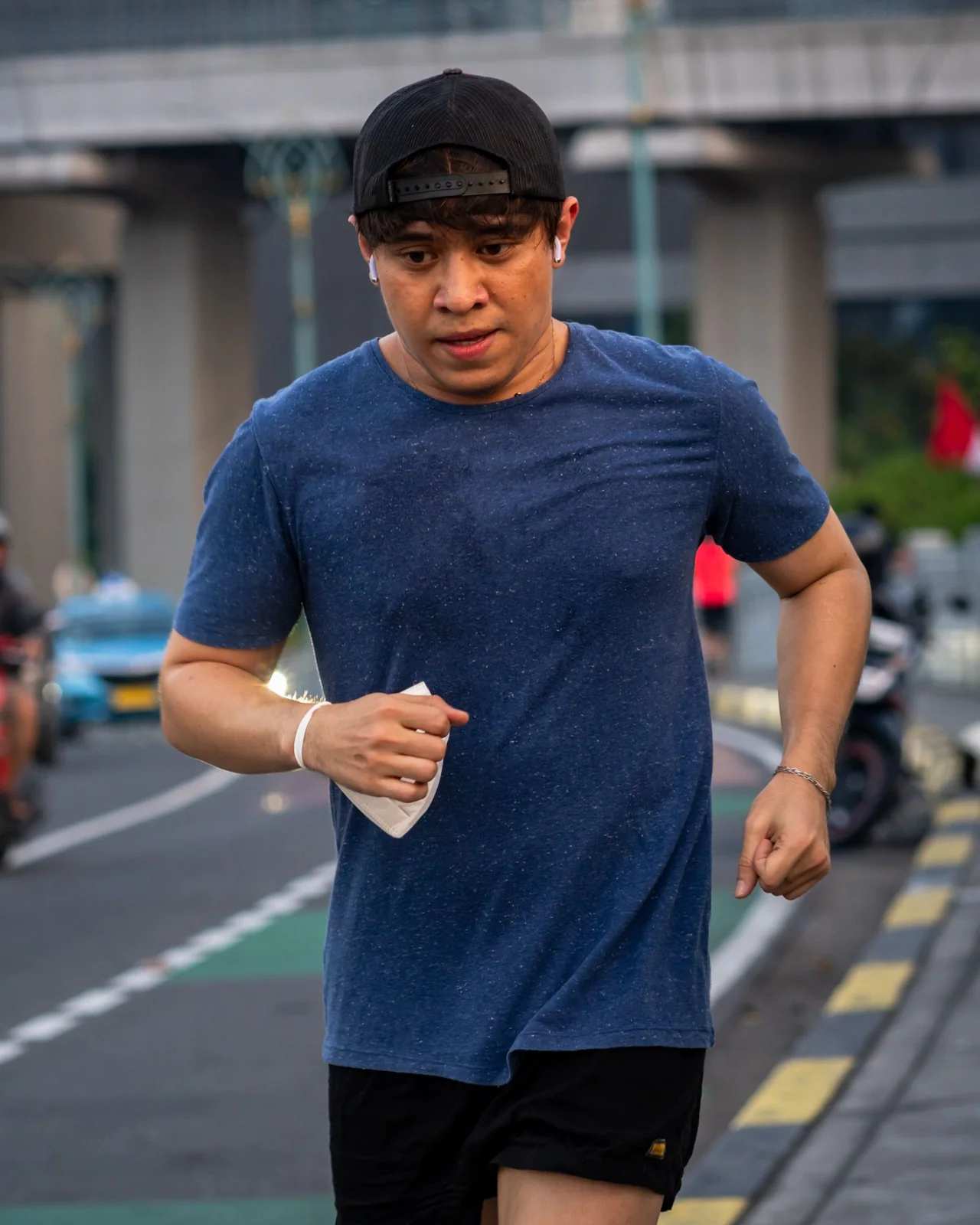
Every runner owns one shirt they quietly stopped wearing. It didn’t rip and it doesn’t smell. It’s the dark patch. Ten minutes in, the chest goes two shades darker, the fabric sticks to you, and by the end of the run it’s slapping against your stomach like a wet tea towel. That shirt was doing something with your sweat. Just not wicking it.
Moisture-wicking fabric is fabric that pulls sweat off your skin, moves it through the knit, and spreads it across the outside surface so it evaporates quickly. In activewear it is usually polyester or nylon, knitted so the spaces between fibres work like tiny channels, and often helped by a wicking finish, a shaped yarn or a two-faced knit. It doesn’t stop you sweating. It stops the sweat sitting on you.
That’s the short answer. Most of what goes wrong with “moisture-wicking” in a product range comes from a few beliefs that sound right and aren’t. Below is how it actually works, then the five we hear most.
How does moisture-wicking fabric work?
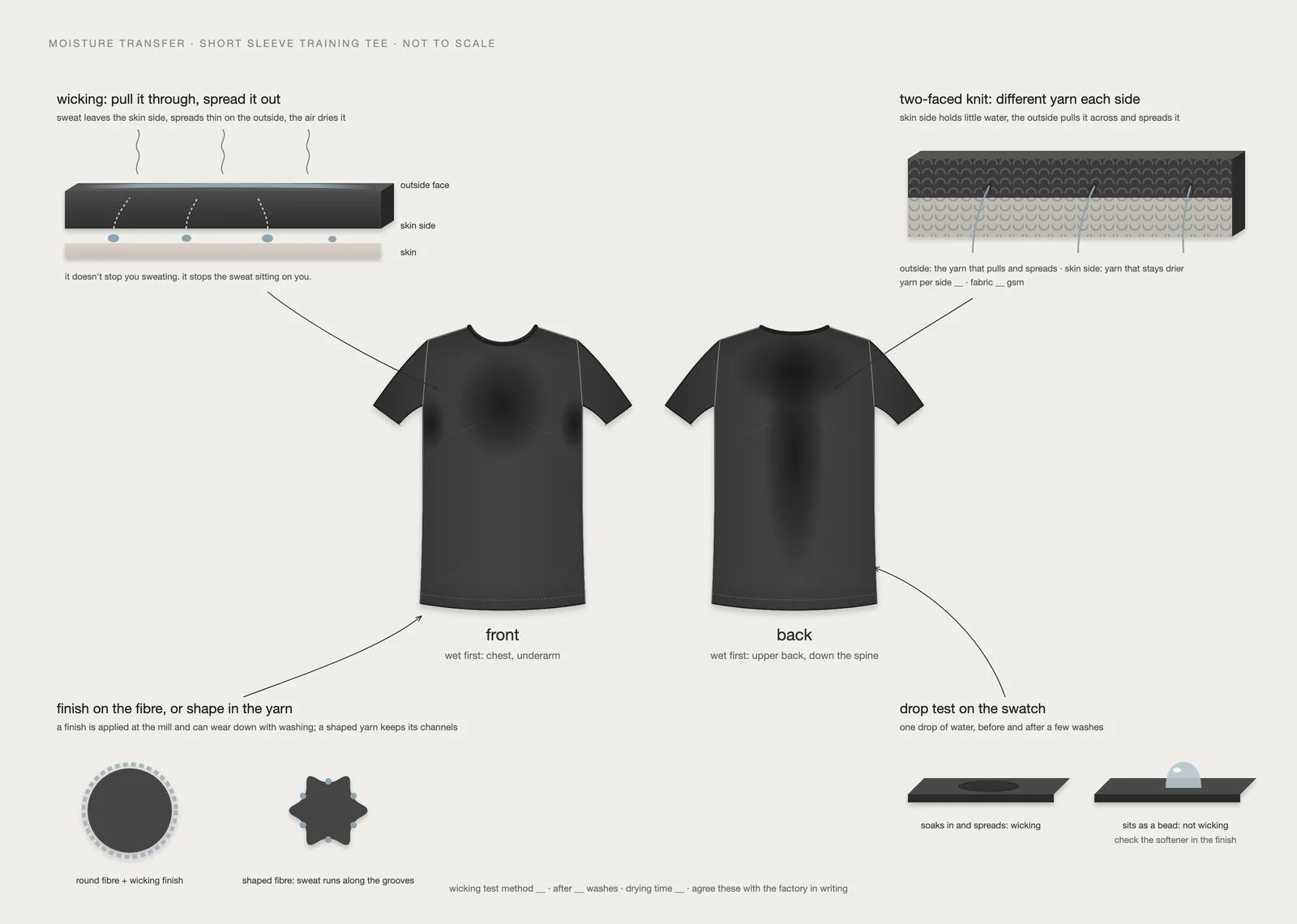
Two jobs, in order. First the fabric pulls liquid sweat away from the skin. That’s capillary action: water travels along the narrow gaps between fibres, the same way it climbs a paper towel dipped in a glass. Finer fibres and tighter gaps pull harder. Second, once the sweat reaches the outside face, it spreads out thin. A thin film dries far faster than a drop, which is why “quick-dry fabric” and “moisture-wicking fabric” are really the same job seen from two ends.
Polyester and nylon take very little water into the fibre itself, so the water stays between the fibres, on the move. Cotton does the opposite. It soaks water into the fibre and keeps it there. Great for a bath towel. Less great at kilometre eight.
Myth 1: “Polyester wicks on its own”
Partly true, and the “partly” is where the trouble starts. Plain polyester is hydrophobic. That’s good for drying, but a surface that dislikes water can also leave sweat sitting on the inside instead of drawing it in, and you get that clammy feel. Mills deal with this in three ways: a hydrophilic finish applied during dyeing and finishing, a yarn with a shaped cross-section (grooves along the fibre that water runs down), or a two-faced knit with a different yarn on each side, so the skin side stays drier and the outside does the pulling and spreading.
When a fabric is sold as moisture-wicking, one of those three is usually doing the work. It’s worth asking which, because they don’t age the same way. If you’re still choosing the base fibre, we went through that in nylon vs polyester.
Myth 2: “Once it wicks, it always wicks”
A wicking finish sits on the surface of the fibre. Wash it enough and it wears down. Some finishes hold up well, some fade after a season of laundry, and the swatch you approved won’t tell you which. A shaped yarn or a two-faced knit is different: the wicking is in the structure, so there’s nothing to wash off.
Our view, for a training tee that goes through the wash every week: build the wicking into the yarn or the knit where the budget allows, and treat a finish as a helper rather than the whole plan.
Myth 3: “Softer is always better”
This one is a sample-room classic. A brand asks for a softer hand feel, more softener goes in at finishing, and the fabric comes back lovely to touch. It also comes back slower to take in water, because some softeners coat the fibre in a way that pushes water away. Nobody did anything wrong. Two reasonable requests just cancelled each other out.
The quickest check is the drop test. Put one drop of water on the swatch, skin side up. On a wicking fabric it soaks in and spreads. On a fabric with a water-shy finish it sits there as a bead, looking back at you. Do it on the approved swatch, and again after a few washes. If the bead shows up, ask what changed in the finish before anyone starts arguing about the yarn.
Myth 4: “Wicking and breathable are the same thing”
Close cousins, different jobs. Wicking moves liquid sweat. Breathability moves air and water vapour through the fabric, and that depends mostly on how open the knit is. A dense, smooth jersey can wick well and still feel warm. An open mesh breathes easily but has less fabric to spread sweat across. Good running and training tops usually use both: a wicking body fabric, with more open panels where heat builds, like the upper back and under the arms.
So when a customer review says a top “doesn’t breathe”, the fix might be a vent panel, not a different wicking fabric.
Myth 5: “Any synthetic counts as quick-dry fabric”
Fibre content is only part of it. Weight matters: a heavier fabric holds more water and takes longer to dry than a light jersey of the same polyester. Brushing the inside for softness, popular on leggings and cooler-weather layers, adds surface that holds on to water. Spandex matters too. It doesn’t wick, so a high-stretch legging fabric relies on the nylon or polyester around it to move the sweat.
Polyester is the usual pick when drying speed comes first, which is why it shows up in so many running tops and shorts. Nylon feels softer and holds a little more water, so it dries a bit slower. In leggings and bras that’s often a fair trade. Merino wool is the natural-fibre exception that handles sweat well, but that’s a different product with different care.
What to write in your tech pack
“Moisture-wicking” in a tech pack is a wish, not a spec. A factory can’t test a wish. Write down:
- The fabric: content, weight in GSM, and where the wicking comes from (a finish, a shaped yarn or a two-faced knit).
- The test, by name. Common ones are AATCC 79 (absorbency, basically a lab version of the drop test), AATCC 197 (vertical wicking) and AATCC 201 (drying rate).
- When to test: on the approved fabric and again after an agreed number of home washes, so a finish that fades shows up before bulk instead of in your reviews.
- How soft is soft enough, if you’re asking for a softer hand, so the softener doesn’t quietly undo the wicking.
You can’t control how hot your customer’s run is. You can control the spec, and the test you agree before bulk.
Where the factory fits in
At New Dong Huang (NDH) we’ve been making activewear since 1999, and the wicking questions that matter almost always come up at the sample stage. Our fabric library lists the nylon and polyester knits we work with by weight, recycled options included, and samples take 7–10 days. That leaves time to run the drop test on the real garment, wash it, and test again before you sign anything off.
If you’re a direct-to-consumer brand planning a first run, our page for DTC activewear brands explains how we work with smaller first orders. Or send us your tech pack and tell us which fabric you’re worried about.