Put two swatches on the table and ask a buyer to close their eyes. Both are soft. Both feel “premium”. More often than not, the answer comes back: “So it’s the same fabric?” It isn’t. It went through a different machine, and that machine decides how warm the legging is, how it looks after twenty washes, and how you should cut it.
Here is the short answer. Brushed fabric and peached fabric are both finishes added to a knitted or woven fabric after it is made. Brushed fabric is run past rollers covered in fine wire that pull fibre ends out of the yarn and lift them into a nap: it ends up softer, warmer and fluffier, and quicker to pill. Peached fabric is run past abrasive rollers that sand the surface down to a short, even fuzz: it ends up smooth and matte, like the skin of a peach, and a little weaker because the sanding wears into the fibre. Brush only the inside of a legging fabric and you get a brushed-back, fleece-lined winter legging.
Two machines, two kinds of soft
Both finishes happen at the mill, on the finishing line, after the fabric is knitted and usually after it is dyed. Nobody brushes a legging once it’s sewn. That matters more than it sounds: if you decide after the sample that you want a different hand feel, you are not asking for a small tweak. You are asking for a different fabric.
On the brushing machine, the fabric runs over a drum of rollers wrapped in wire “card clothing”, thousands of tiny hooked points. They catch the loose ends of the filaments and pull them up and out. Pass the fabric through again and the nap gets taller and denser. You can see it: hold a brushed fabric to the light and there’s a soft haze standing off the surface.
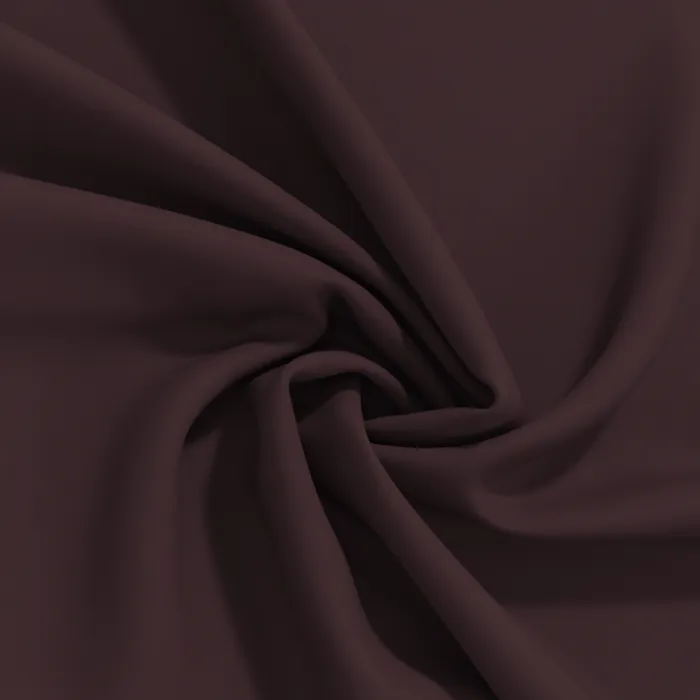
A peaching (or sueding) machine swaps the wire for rollers coated in something abrasive, like fine sandpaper. Instead of pulling fibres out, it shaves the very top of the surface into a fuzz so short you mostly feel it rather than see it. The fabric goes flat and slightly matte. Shiny polyester stops looking like polyester.
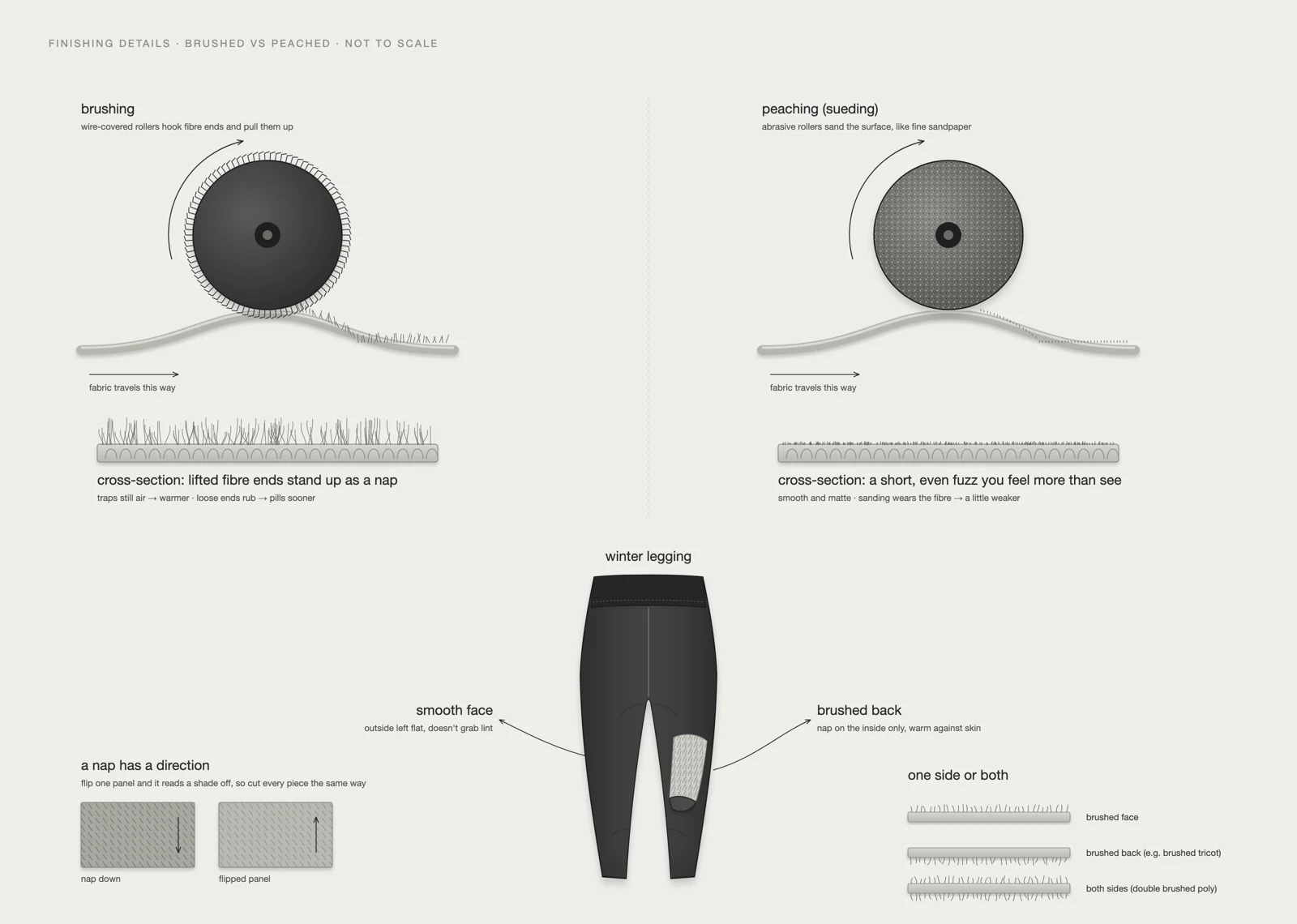
The quickest way to tell them apart in a sample room: run your thumb across the swatch, then back. Brushed fabric has a nap that moves and changes shade under your thumb. Peached fabric just feels like suede and doesn’t change much either way.
What is brushed fabric, and what it costs you
Those lifted fibres trap a thin layer of still air next to the skin. That’s why brushed fabric feels warm the second you put it on, and why it’s the standard for cold-weather base layers and fleece-lined leggings. It also feels cosy in a way a flat fabric doesn’t, which is half the reason “buttery soft” loungewear sells.
The catch is the same thing that makes it soft. You have pulled fibre ends out of the yarn on purpose. Loose ends rub, tangle and roll up into little balls, so brushed fabric pills sooner than the same fabric left unbrushed, especially on the inner thighs and under a backpack strap. If pilling is already on your list of complaints, read why leggings pill and what actually helps before you ask for more brushing.
There is one more thing you only learn on the cutting table. A nap has a direction. Lay one panel upside down next to the others and under light it reads as a slightly different shade, even though it came off the same roll. So brushed fabrics get cut with every piece facing the same way. That uses a bit more fabric than a free layout, and it’s worth knowing before the costing comes back.
What is peached fabric?
Peached fabric is the quieter of the two. The surface goes smooth and dry to the touch, with a soft matte look, and it doesn’t add much warmth because there’s no tall nap to hold air. That makes it a good fit for spring and summer pieces where you want the fabric to feel nice without feeling heavy: yoga leggings, bras, tees, lighter training tops.
The trade-off is strength. Sanding takes a little off every fibre it touches, so a peached fabric is slightly weaker than the same fabric untouched. On a mid-weight legging fabric you won’t notice. On a very light fabric, or a panel that gets stretched hard, it’s something to check on the sample rather than assume.
You can peach one side or both. One side is the usual choice when only the inside touches skin and you want the outside to keep its clean, slightly sharper look.
Double brushed poly and brushed tricot
These are the two names you’ll keep running into on fabric lists and supplier pages.
Double brushed poly (often shortened to DBP) is a polyester and spandex jersey brushed on both the face and the back. It’s very soft, drapes well and is a favourite for leggings, lounge sets and printed basics. Because both sides are brushed, it pills more easily than most performance fabrics and isn’t built for high-abrasion training. Great for comfort. Not the one we’d pick for a squat-heavy gym legging.
Brushed tricot is a warp-knitted fabric (tricot is the knit structure, not the fibre) brushed on one side, usually the back. The face stays smooth and firm; the inside feels soft against the skin. You see it in jackets and track pants as a soft lining layer, and in some leggings where a brand wants a smooth outside and a gentle inside.
When a fabric list just says “brushed polyester”, ask which side, and whether it’s brushed once or more. Those two answers tell you more about the feel than the name does. If you’re still choosing the base fibre, nylon vs polyester is the decision that comes before the finish.
Which finish for which garment
Our honest view: start from the garment and the season, not from the word “soft”.
A winter running or outdoor legging wants a brushed back. Smooth outside so it doesn’t grab dust and lint, brushed inside so it’s warm. A spring yoga legging usually wants either a peached face or no finish at all, because warmth is the last thing you want in a hot studio. A lounge set that will mostly be worn on the sofa can be double brushed, and nobody will complain.
A common mistake is asking for every piece in a range to be brushed because one sample felt amazing. A few months later, the reviews start mentioning pilling. We’d rather you pick one or two hero fabrics, give each a finish that suits what it’s for, and tell that story properly on the product page. “Brushed inside for winter runs” is something a customer understands. “Buttery soft” on everything stops meaning anything.
When you put it in a tech pack, write the finish next to the fabric (brushed, peached or none), which side, and the season the piece is for. Then judge it on a washed sample, not a fresh swatch. Brushing and peaching both look their best on day one.
Developing a brushed or peached legging
New Dong Huang (NDH) has been making activewear in Dongyang, China since 1999, mostly leggings, bras, shorts and training tops for growing brands. We make samples in 7–10 days, so it’s easy to put a brushed and a peached version side by side before you decide. You can browse fabrics on our raw material page, or send us the style and the season and we’ll tell you which finish we’d use and why.
Originally shared on Instagram: https://www.instagram.com/p/DesmsahjHVm/