There are three ways to sort the types of sports bras: by how much support they give, by how that support is built, and by how the back and closure are made. Most guides stop at the first one. If you are designing a sports bra rather than buying one, the other two matter just as much, because they decide how the bra is patterned, what trims it needs and what the factory has to get right.
Types of sports bras by support level
- Low support. For yoga, pilates, walking and everyday wear. Usually lighter fabric, thinner straps, a pullover shape and less structure in the band.
- Medium support. For gym training, cycling and mixed workouts. A firmer band, wider straps and often removable pads.
- High support. For running and high-impact training. The most structure: a stronger band, a higher neckline, and often adjustable straps or a back closure so the fit can be set tightly.
Across all sports bra types, support level is mostly a product of the band, the fabric and the construction below, not of the style name. Two bras that look alike can land in different support levels depending on fabric weight, recovery and how the band is finished.
Compression, encapsulation and combination
The second way to sort different types of sports bras is by how they hold:
- Compression bras press the chest against the body to reduce movement. Simple to make, often one piece of fabric with a lining, and common in low and medium support.
- Encapsulation bras support each side separately, with shaped cups or panels, closer to an everyday bra. They need more pattern pieces and more precise sewing.
- Combination bras use both: separate cup shaping plus a compressive outer layer. Common in high-support styles.
For a brand, this choice sets the number of pattern pieces, whether you need moulded or cut-and-sewn cups, and how much fit sampling to expect.
Sports bra back styles
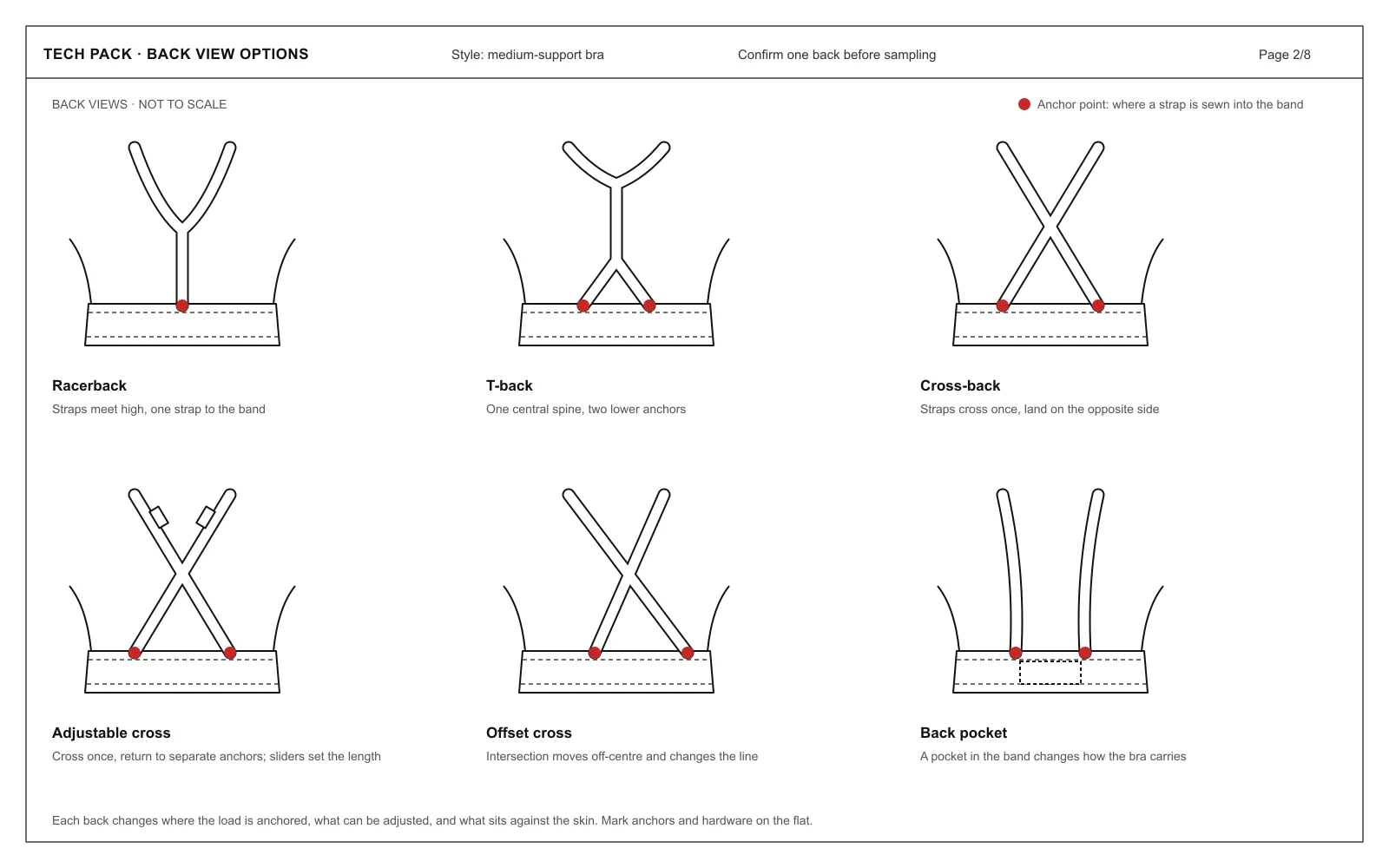
The back is part of the product. Each back style changes how the bra wears, adjusts and carries, and each one sets where the straps are anchored into the band. The visual line matters, and so do the anchor points, the hardware placement and what sits against the skin.
Racerback
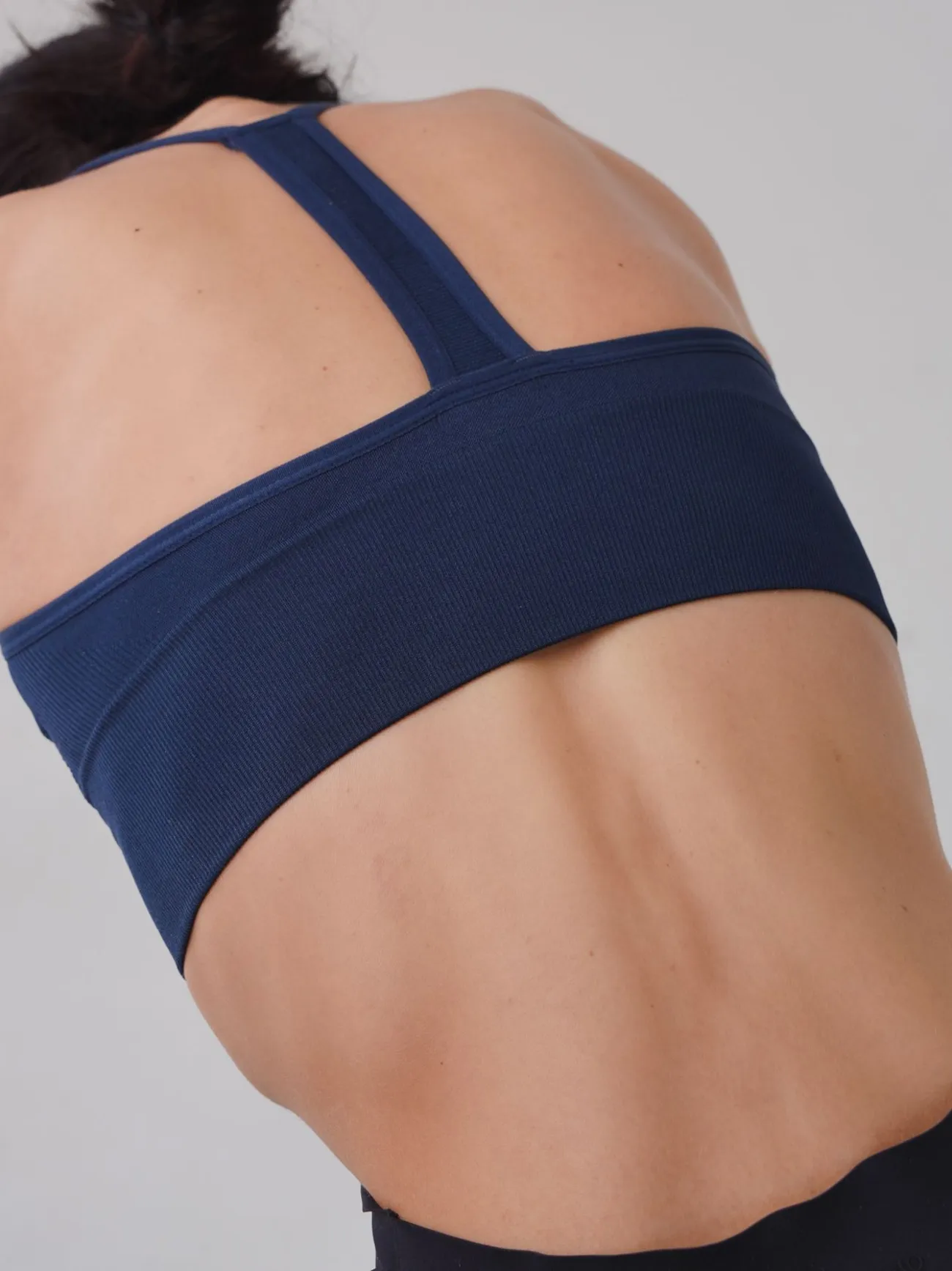
The straps meet high between the shoulder blades and run to the band as one strap. They stay on the shoulders during movement, which is why the racerback is the default for running and training bras.
T-back
One central spine, with two lower anchors. It gives a clean, open look across the shoulder blades while spreading the load across two points on the band.
Cross-back
The straps cross once and land on the opposite side of the band. It opens up the upper back and pulls the straps inward, which helps them stay on narrow shoulders.
Adjustable cross
Two straps cross once, then return to separate anchors, with sliders to set the length. Adjustability is what makes it work for a wider range of bodies, but it adds hardware: sliders, rings or hooks that have to be placed so they do not sit on a pressure point.
Offset cross
The intersection shifts off-centre and changes the visual line. It is mainly a design statement, but it also changes where the load sits, so it needs checking on a moving fit model, not only on a mannequin.
Strappy and open backs
Multiple thin straps or a low, open back. They look light, but every extra strap is another anchor, another seam and another place to finish cleanly.
Back pocket
A pocket built into the band changes how the bra carries: a phone, a key or a gel sits against the spine rather than in the hand. The pocket opening, its lining and how it is bonded or sewn all need to be written into the construction page.
Closures and adjustability
- Pullover. No hardware, quickest to make, and the most common for low and medium support.
- Back hook-and-eye. Lets the band be tightened, useful for high support and for customers between sizes.
- Front zip. Easy on and off for high-support styles, but the zip and its facing have to lie flat against the chest.
- Adjustable straps. Sliders on the straps, placed away from the shoulder top where they would press.
What to put in a sports bra tech pack
Whatever the type, a sports bra tech pack should say, in writing:
- support level and construction: compression, encapsulation or both
- back style, with every anchor point marked on the back view
- band: elastic type and width, how it is finished, and where it is joined
- pads or cups: removable or fixed, and the pad pocket opening
- hardware: sliders, hooks, zips, with supplier, size and finish
- fabric and lining, including weight and stretch recovery
Our guide to what goes into a tech pack covers the rest of the pages.
Developing sports bras with us
We make sports bras alongside leggings, shorts and tops for activewear brands, including matching sets for yoga and gym training. Tell us the support level and the back you have in mind, or send a reference bra, and we will talk through construction before sampling. Our minimum is 500 pieces per colour per style. Get in touch.
Originally shared on Instagram: @william.activewear.factory