Turn a patterned legging inside out and examine how the pattern is formed. Floats, backing stitches or a reversed pattern can offer clues, but the back alone is not a conclusive test: print penetration and jacquard structures vary. Look closely at the yarns and confirm the construction with the fabric supplier.
So, what is jacquard fabric? Jacquard is fabric where the pattern is made by the yarns themselves while the cloth is knitted or woven, instead of being printed, dyed or embroidered on afterwards. The machine decides, needle by needle or thread by thread, which colour or stitch comes to the surface. The name comes from Joseph Marie Jacquard, whose loom attachment from the early 1800s used punched cards to lift each warp thread on its own. This guide focuses on knit jacquards for activewear. Stretch and recovery still depend on the yarns, knit structure and finish.
Woven jacquard vs knit jacquard
Most of what you’ll find when you look up jacquard is the woven kind: damask tablecloths, brocade jackets, upholstery. Those are made on a loom with two sets of yarn crossing at right angles. Those examples are often structured, but woven jacquards can also be lightweight or stretchy. Jacquard describes how the pattern is produced, not a fixed weight or stretch level.
Knit jacquard is built from loops, like every other knit. A computer-controlled knitting machine picks, for every needle in every row, which yarn gets knitted to the face. Feed in two or three colours of yarn and the pattern appears as the fabric comes off the machine. Its stretch and recovery need to be specified and tested for the garment; a knitted construction alone does not guarantee legging performance. Yarn choices, including spandex, are part of that specification.
In an activewear range, jacquard usually turns up in three places: all-over textured fabric for leggings and bras, knitted-in zones on circular-knit (seamless) pieces, and the elastic inside a waistband, where a logo can be knitted or woven into the band itself.
Four things people get wrong about jacquard
“Jacquard is a type of fabric”
It’s a way of making a pattern, not a material. A jacquard can be nylon/spandex, polyester/spandex, cotton or wool. So when a tech pack says “jacquard” and nothing else, the factory still needs the same things it needs for any fabric: fibre content, weight in GSM, and which side is the face.
“It’s basically a fancier print”
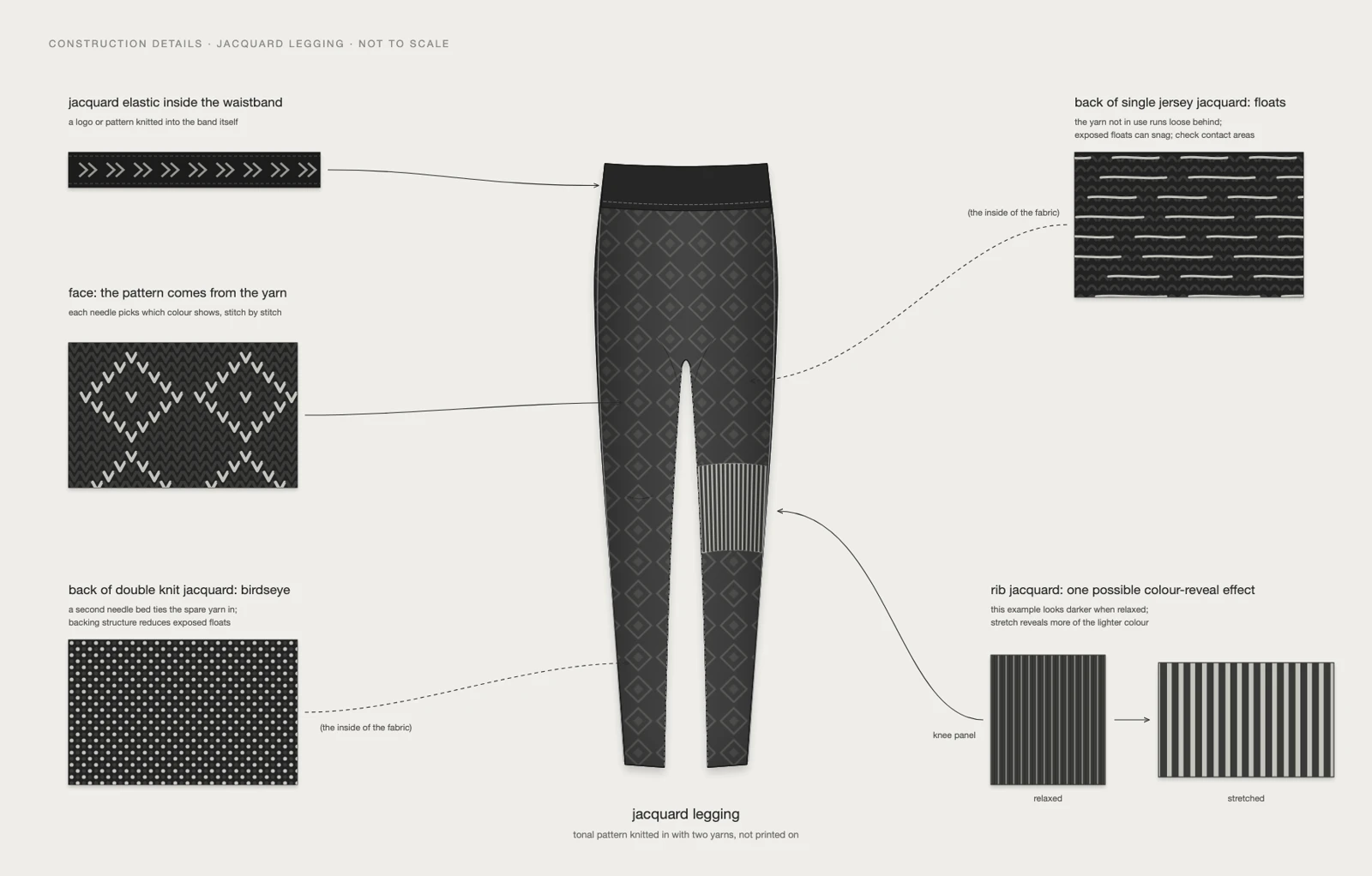
The difference is on the inside. In a single jersey jacquard, the yarn that isn’t showing on the face has to go somewhere, so it runs loose across the back until it’s needed again. Those loose runs are called floats. Exposed floats can snag; the risk depends on their length, location and how the garment is worn. Check contact areas and test the actual construction.
In many double-knit jacquards, a second needle bed incorporates yarn into a backing structure, reducing exposed floats. Birdseye and striped backs are examples; the actual structure should be checked on the swatch. It’s firmer and a little heavier. For leggings we’d go double knit nearly every time. Single jersey jacquard is better kept for pieces with a lining over the back, or for looser tops where nothing rubs against it.
“Jacquard costs about the same as a print”
Usually it doesn’t. Yarn consumption and cost depend on the jacquard structure, number of colours, weight and order size; a backed construction may use more yarn than a comparable plain knit. Each new design needs a new knitting program and a new round of fabric development. A new colourway may use available yarn colours or require new yarn dyeing. Approve the yarn colour against the agreed reference before knitting; a lab dip is part of the colour-approval process. And you’re limited to the number of yarns the machine can feed.
A print, by comparison, is artwork. Change it next season, add a colour, move it. For a brand doing a first run of two or three styles, a solid fabric or a print is usually the easier start, and jacquard comes in once you know which style is going to reorder. We talk through that kind of planning on our page for DTC brands.
“Rib jacquard is just a printed stripe”
A two-colour rib jacquard can use the rib structure to change how much of each colour is visible when stretched. That is one possible effect, not a feature of every rib jacquard. There’s no ink anywhere. We filmed one up close on Instagram if you want to see it move.
Printing on a rib is also possible. A surface print needs to suit the fabric extension; cracking depends on the print system, application and use, and is not inevitable. A knitted-in pattern avoids an applied print layer, but still needs stretch, recovery, snagging and wash checks.
Where jacquard earns its place
Here’s our honest view: jacquard works best as one hero fabric, not a range of novelties. A tonal jacquard, where both yarns are close in colour and the pattern shows up mostly as texture, gives a range something to talk about without a loud print. And because the pattern lives in the knit, it carries over season to season. You change the yarn colour, not the design.
It’s less useful in the places nobody sees. Gussets, pocket bags and waistband facings are better in a plain knit from our fabric library. Put the jacquard on the legs and the front panel of a bra, where the customer actually looks.
What to check on a jacquard sample
When the first sample arrives, start by turning it inside out. Run a fingernail across the back. If it catches on floats, think about where those floats will sit on the body and what will rub them.
Then stretch it where it works hardest, across the seat and the knee. On a rib jacquard designed for a colour-reveal effect, check that the second colour appears as intended. On a tonal jacquard, visible backing colour may be undesirable. If the back colour “grins through” when you stretch it, the yarn colours or the structure need another look.
Check the weight against what’s on the tech pack, because jacquard often comes out heavier than the plain fabric you were comparing it to. Wash it a few times and look at the back again. And look at the seams: a jacquard pattern won’t line up across a side seam unless the pattern pieces are laid on the repeat, which uses more fabric. Decide early whether you care.
New Dong Huang (NDH) has been making activewear in Dongyang, China since 1999. We can develop jacquard knits for leggings and bras alongside plain fabrics, and once the fabric is settled, samples take 7–10 days.
Thinking about jacquard for your next range?
Send us a photo of the texture or pattern you have in mind and the style you want it on, and we’ll tell you whether it should be a jacquard, a print or something simpler. You can reach us through our contact page.