Write “stretchy” on the fabric line of a tech pack and you have described about half the fabrics on earth. It also skips the one question that decides how a garment gets cut, sewn and tested: knit vs woven?
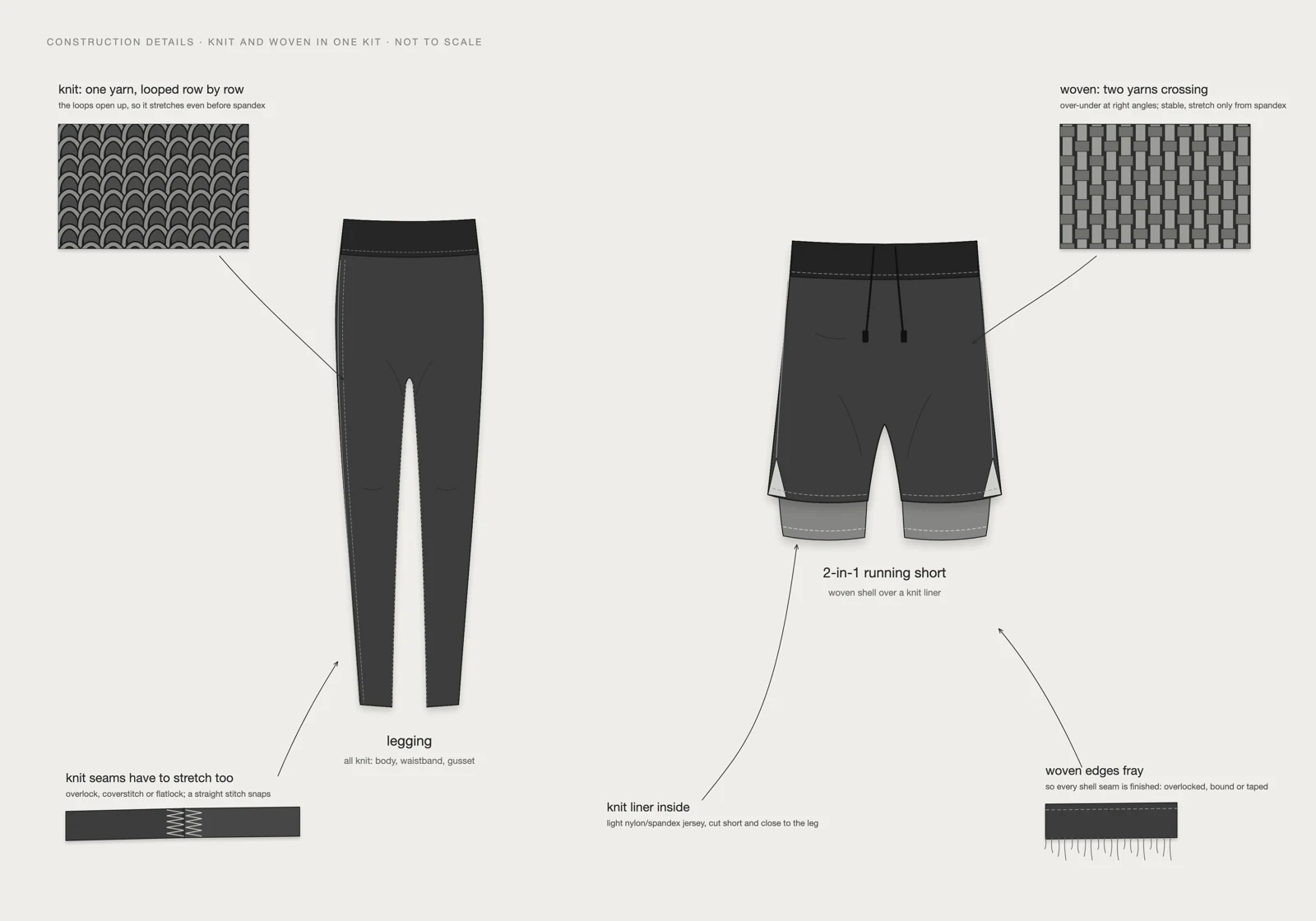
Here is the short answer. Knit fabric is made from one yarn pulled through itself in rows of loops, so it stretches and recovers on its own. Woven fabric is made from two sets of yarn crossing over and under each other at right angles, so it holds its shape and only stretches if spandex is added. In activewear, knits go next to the skin (leggings, sports bras, tees, liners) and wovens go where you want structure, wind resistance or a lighter, drier feel (running short shells, jackets and layers).
Knit vs woven fabric: three tests in the sample room
You don’t need a lab to tell them apart. Most of the time we find out in about ten seconds, standing at the cutting table with a swatch.
Pull it. A knit gives in both directions, more in the width than the length. A woven barely moves along the grain, unless there is spandex in it, and even then it feels firmer and springs back faster. Pull a woven on the diagonal (the bias) and it gives a little. That’s the only “free” stretch a woven has.
Look at the cut edge. Snip a corner. A woven starts shedding threads straight away, because the crossing yarns have nothing holding them once they are cut. A knit doesn’t fray. Single jersey curls at the edge instead, which is its own small annoyance on the cutting table.
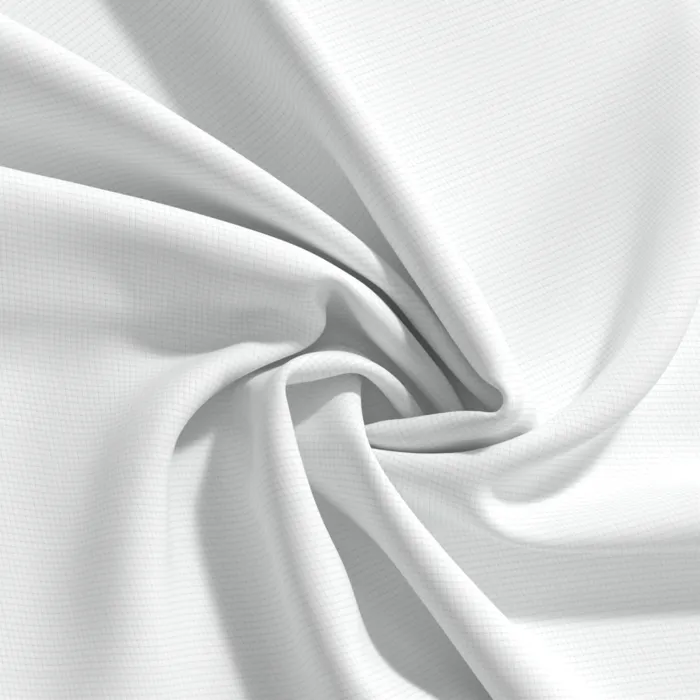
Look closely at the face. On a knit you’ll see little V shapes or columns of loops. On a woven you’ll see a grid, like a very fine basket. Twill and ripstop wovens show a diagonal or a square pattern on top of that grid.
That’s it. Everything else about knit vs woven, the feel, the price, the way it gets sewn, comes back to those loops and that grid.
Where each one goes in an activewear range
Here’s the thing: most kits use both. A good example is the 2-in-1 running short. The outer shell is a light woven, usually polyester or nylon with a bit of spandex, because it needs to feel dry, move air and not cling to the leg. The liner underneath is a nylon/spandex knit, because it sits on skin and has to stretch with every stride. Two fabrics, two jobs, one garment.
Knits are the default for anything close to the body:
- leggings and bike shorts (interlock and warp knits with spandex)
- sports bras and bra linings
- training tees, tanks and long sleeves
- short liners, gussets and waistband facings
Wovens earn their place where the garment should hold its own shape:
- running and training shorts (the shell)
- wind jackets, packable layers and vests
- pockets and panels that shouldn’t stretch out, like a phone pocket you don’t want sagging
The catch is the in-between garments. A “stretch woven” with spandex can make a good jogger or a training pant, but it will never feel like a legging. If your customer expects the hug of a legging, you want a knit. If they want something that looks crisp and doesn’t show every line of the body, a stretch woven is usually the better call.
What changes on the factory floor
This is the part brands don’t see, and it’s where knit and woven really go different ways.
Knit seams have to stretch as much as the fabric. That means overlock, coverstitch or flatlock machines, with stitches that zigzag and loop so the thread can open up when the fabric does. Put a plain straight stitch on a legging side seam and it lasts exactly one squat.
Woven seams don’t need to stretch much, so a straight lockstitch works. But every raw edge on a woven has to be finished, because it frays. So the inside of a woven shell gets overlocked, bound, folded and topstitched, or taped. When you turn a well-made running short inside out, a lot of what you’re looking at is fray control.
Cutting is different too. Knits relax after they come off the roll, so they are usually left to rest before cutting, or the pieces shrink back after they are cut. Wovens are steadier on the table, but the grain line matters a lot more: cut a woven a few degrees off grain and the leg will twist after washing.
Fit is the other big one. A knit pattern is often cut smaller than the body (that’s “negative ease”) and the stretch does the rest. A woven pattern has to be cut with room to move, or the wearer can’t lift a knee. Same size label, very different pattern.
Is knit or woven better for activewear?
Neither. It depends on the job. Honestly, the question we’d ask is “what does this piece have to do?” If it has to move with the body and sit on skin, knit. If it has to keep its shape, block wind or feel light and dry over the top of something else, woven.
What we would push back on is using too many of each. We’d rather see a brand pick one hero knit and one hero woven for a season and build the range around them, than juggle eight fabrics that each appear on one style. Fewer fabrics means a cleaner story for your customer, and fewer things to colour-match across the range.
What to write on your tech pack
Replace “stretchy” with a few plain facts:
- knit or woven, and the construction if you know it (interlock, jersey, ripstop, plain weave)
- fibre content, for example nylon/spandex or polyester/spandex
- weight in GSM
- which pieces use which fabric (shell, liner, waistband, pockets)
- how much stretch you need, and in which direction
If you don’t know some of these yet, that’s normal. A reference garment you like tells a factory more than any adjective. New Dong Huang (NDH) has been making activewear in Dongyang, China since 1999, and we develop both knit and woven pieces, with samples in 7–10 days.
Building a range with both
If you’re planning leggings and bras alongside shorts or a light layer, it helps to sort the knit vs woven question before the first sample, not after. Tell us what each piece needs to do and we’ll suggest fabrics for each. You can reach us through our contact page.