Two new brands launch the same week. Same black legging, same waistband, same little key pocket at the back. Different logo on the hip. Neither of them copied the other. They ordered from the same catalogue. That’s white label, and it’s the easiest way to see the difference.
Here is the short answer. White label activewear is a finished product a supplier already makes and sells to anyone who asks; you add your logo or your label, and the garment itself doesn’t change. Private label activewear starts from a manufacturer’s proven style and fabric but is made for your order: you choose the colour, can swap the fabric, change lengths, pockets and trims, and put your own labels and packaging on it. White label is quicker and cheaper to start. Private label needs a sample and a minimum order, and the product ends up yours.
Why private label and white label get mixed up
Outside clothing, the two words drift. In software and supplements people use them almost interchangeably, and you’ll find articles online that define them the opposite way round. In apparel the useful line is simple: does the garment change, or only the label? If only the label changes, it’s white label. If the garment changes for you, it’s private label. If you bring your own pattern and tech pack, it’s neither. That’s full custom, which factories usually call OEM.
So when you email a factory, describe the change instead of leaning on the word. “Your high-rise legging in our sage, with our waistband label and a shorter inseam” gets you a real quote. “White label please” gets you a question back.
One legging, three routes
Take one high-rise legging and walk it down each road.
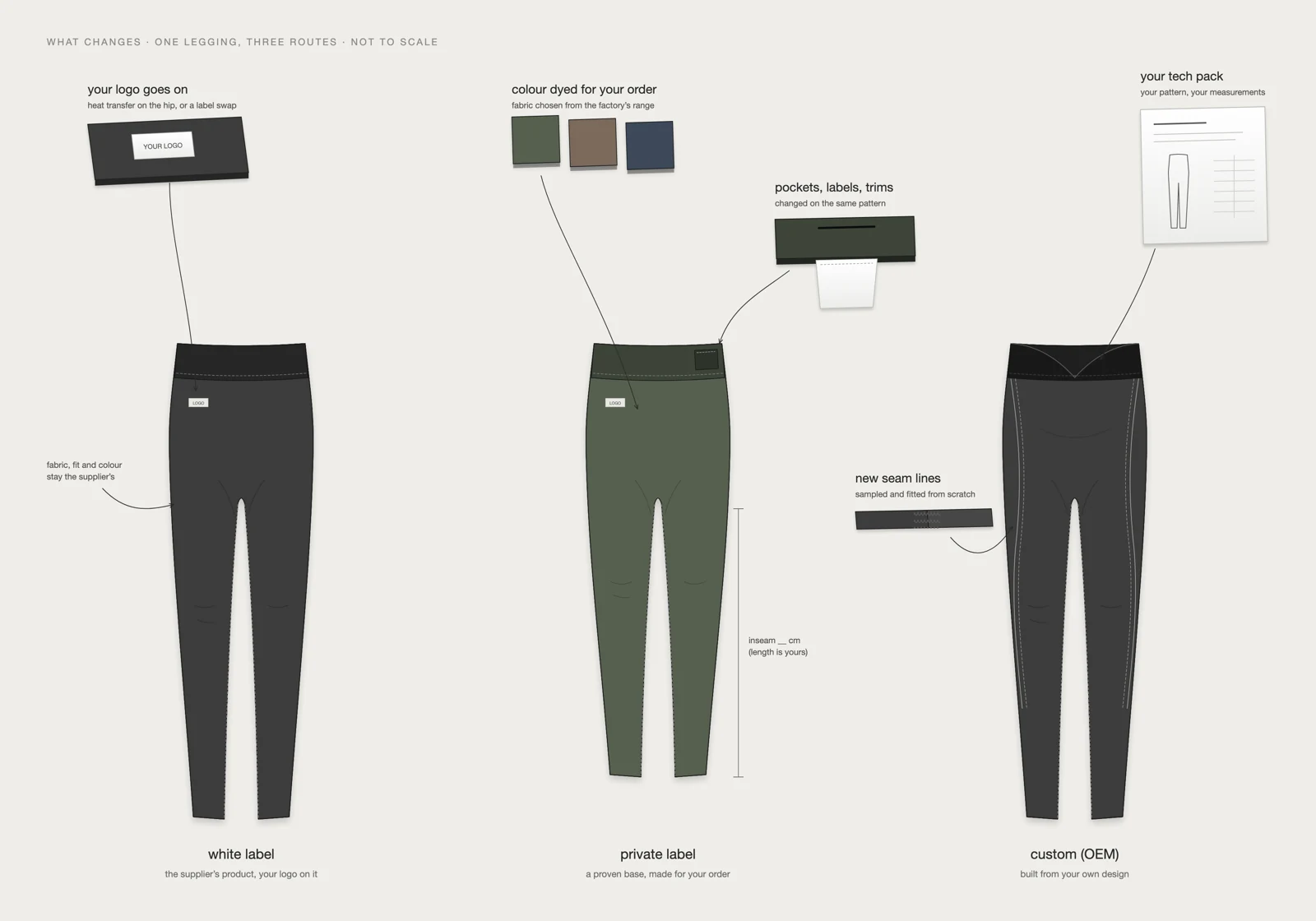
White label. The legging already exists, in the colours the supplier keeps running. You pick a colour and a size run, and your logo goes on: usually a heat transfer on the hip or waistband, sometimes a swapped neck or care label. Minimums are low because the supplier sells the same garment to a lot of brands. The catch is in that sentence. Anyone can buy it, including the brand that shows up next to yours in a customer’s feed, and you have very little say over the fabric, the fit, or what happens when the supplier quietly changes mills.
Private label. You start from the same kind of base, a pattern and fabric the factory has already sampled and made in bulk. Then you change what matters to your customer. On our private label activewear programme that list is colour, fabric, logos, labels and tags, lengths and pockets, trims, packaging and the size range. Because the pattern is proven, you skip most of the fit rounds. But the fabric is dyed and cut for your order, which is why there is a sample and a minimum. At New Dong Huang (NDH) that minimum is 500 pieces per colour per style, and samples take 7–10 days.
Custom (OEM). Your designer sends a tech pack: your pattern, your measurements, your fabric. The factory develops it from nothing. More sampling, more of your time, and the most room to make something nobody else has. We do this for leggings, sports bras, shorts and tops.
What you actually control
The difference between white label and private label rarely shows on launch day. It shows a year later, on the reorder.
Fabric is the big one. With white label you get whatever fabric the supplier runs, and if it pills after a few washes, it pills for every brand selling it. With private label you choose the fabric and you keep it. When you reorder, you’re asking for the same fabric again, dyed to the same approved lab dip. That’s what makes the second run look like the first.
Colour is the second. White label colours are the supplier’s colours. Private label colours are dyed for you, so a sage that matches your brand is possible, and so is a sage that matches your last drop.
Fit is the third. White label sizing is built to suit as many brands as possible, which in practice means it suits nobody exactly. Private label lets you move an inseam or raise a waistband without paying for a whole new pattern.
Then there’s the small stuff customers notice without knowing why. A softer label. A brushed waistband lining. A pocket that actually fits this year’s phones.
Cost, minimums and speed
White label wins at the very start. No sample round, small quantities, stock in hand fast. If you’re testing whether anyone will buy from you at all, that’s a fair way to find out.
Private label costs more upfront because every order is produced for you. Fabric is knitted and dyed by the batch, trims have their own minimums, and the factory quotes around all of that. It’s also why you can’t order 50 private label leggings in five colours (we do get asked). If you’re planning a first run, our guide to planning around an MOQ walks through fitting a range inside 500 per colour per style.
Per-piece price depends on fabric, trims and quantity, so I won’t put a number on it here. Anyone who quotes you a figure before seeing the style is guessing.
Which one should you start with?
If you’re still finding out whether people want your brand at all, white label is a cheap test. Just don’t build the brand story on the product, because the product isn’t yours.
If you already know who your customer is and what they wear, start private label with a small core: two or three styles, one or two fabrics, colours you plan to keep. Many of the DTC brands we work with started exactly like that, with two or three styles on the first run, and it’s still what we’d recommend. A few hero fabrics with a clear story beat a big range nobody remembers.
When a style sells and you want a version only you have, that’s when custom development earns its cost. By then you’ll know what to change, because your customers will have told you.
Questions brands ask
Is private label the same as OEM?
Not quite. In private label the factory’s base style is the starting point and you customise it. In OEM you bring the design and the factory makes it to your spec. Both end with only your brand on the label.
Can I move from white label to private label later?
Yes, and plenty of brands do. Keep a list of what customers complain about in the white label product. That list is your first private label brief.
Starting a range
We’ve been making activewear in Dongyang, China, since 1999, especially for brands that sell direct to their own customers. If you have a style in mind, send us a photo or a tech pack and tell us what you’d change. Email our sales team and we’ll tell you which route fits.