Lay three swatches on a cutting table and walk away for ten minutes. One of them will have rolled itself into a tube. One will have pulled in narrower than you cut it. One will be lying exactly where you left it. That’s single jersey, rib knit and interlock, and most of what a brand needs to know about them is in that little scene.
Here is the short version. Rib knit fabric has knit and purl columns that alternate, so it looks the same on both sides and stretches a long way across its width, which is why it’s used for neckbands, armhole bindings and cuffs. Interlock fabric is a double knit: two layers of rib knitted into each other, smooth on both faces, stable, opaque and flat at the cut edge, which is why so many leggings are made from it. Single jersey is the lightest of the three, has a different face and back, and curls at the edge. In one outfit you often use all three.

What is rib knit fabric?
Rib is knitted on a machine with two sets of needles facing each other. One set makes knit stitches, the other makes purl stitches, and they take turns column by column. In a 1×1 rib it’s one knit column, one purl column. In a 2×2 it’s two and two. Turn the fabric over and you see the same pattern, just shifted.
When rib is relaxed, the purl columns tuck in behind the knit ones and the fabric looks narrower than it really is. Pull it sideways and those columns open up. That’s where rib gets its width stretch, and it’s also why it snaps back so well. A neckband needs exactly that: it has to stretch over a head and then sit flat against the neck again.
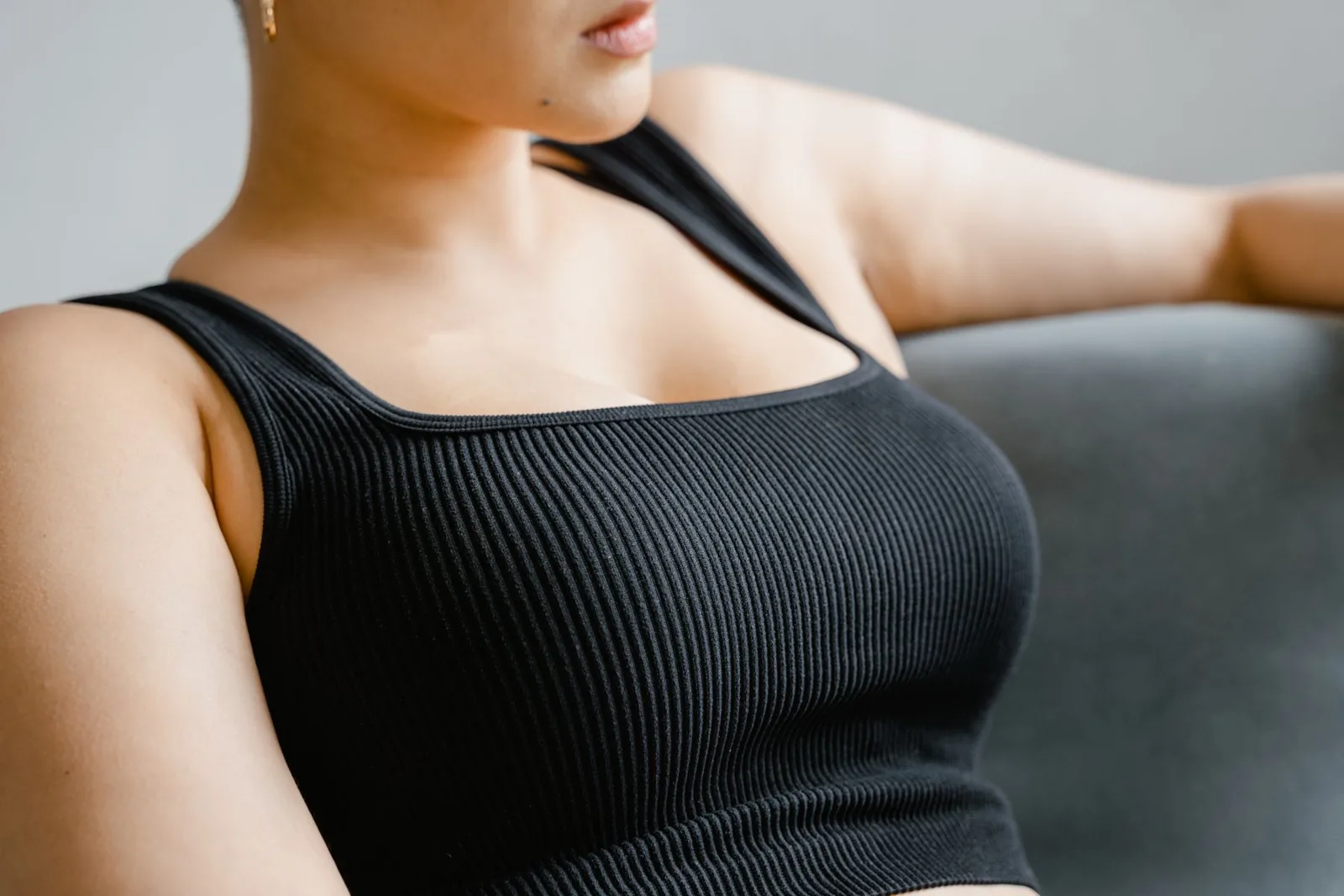
Rib doesn’t curl at the edge, which makes it easy to sew as a binding. The catch is that it comes off the roll under tension. Cut it before it has relaxed and the band you sew on today is not the band you have after the first wash.
What is interlock fabric?
Interlock is also knitted on two sets of needles, but the needles are arranged so that two 1×1 rib structures knit into each other. The result is one fabric with two layers of loops locked together. Both sides look like the smooth face of a jersey. You can’t really tell the front from the back, and you can’t see through it.
That last part is the reason it shows up in leggings. When a legging stretches over the seat in a squat, a single layer of loops opens up and light gets through. With interlock there is always another loop behind the gap. We went through the rest of that problem in our piece on squat proof leggings.
Interlock is also stable. It stretches less across the width than rib does, it lies flat when you cut it, and it holds its shape on a long panel like a legging leg or a high waistband. You pay for that in weight: for the same yarn it’s thicker and heavier than a single jersey.
Where each knit goes in one outfit
Take a simple training set: a tank top and a legging. It’s easier to see the difference on a real garment than in a table.
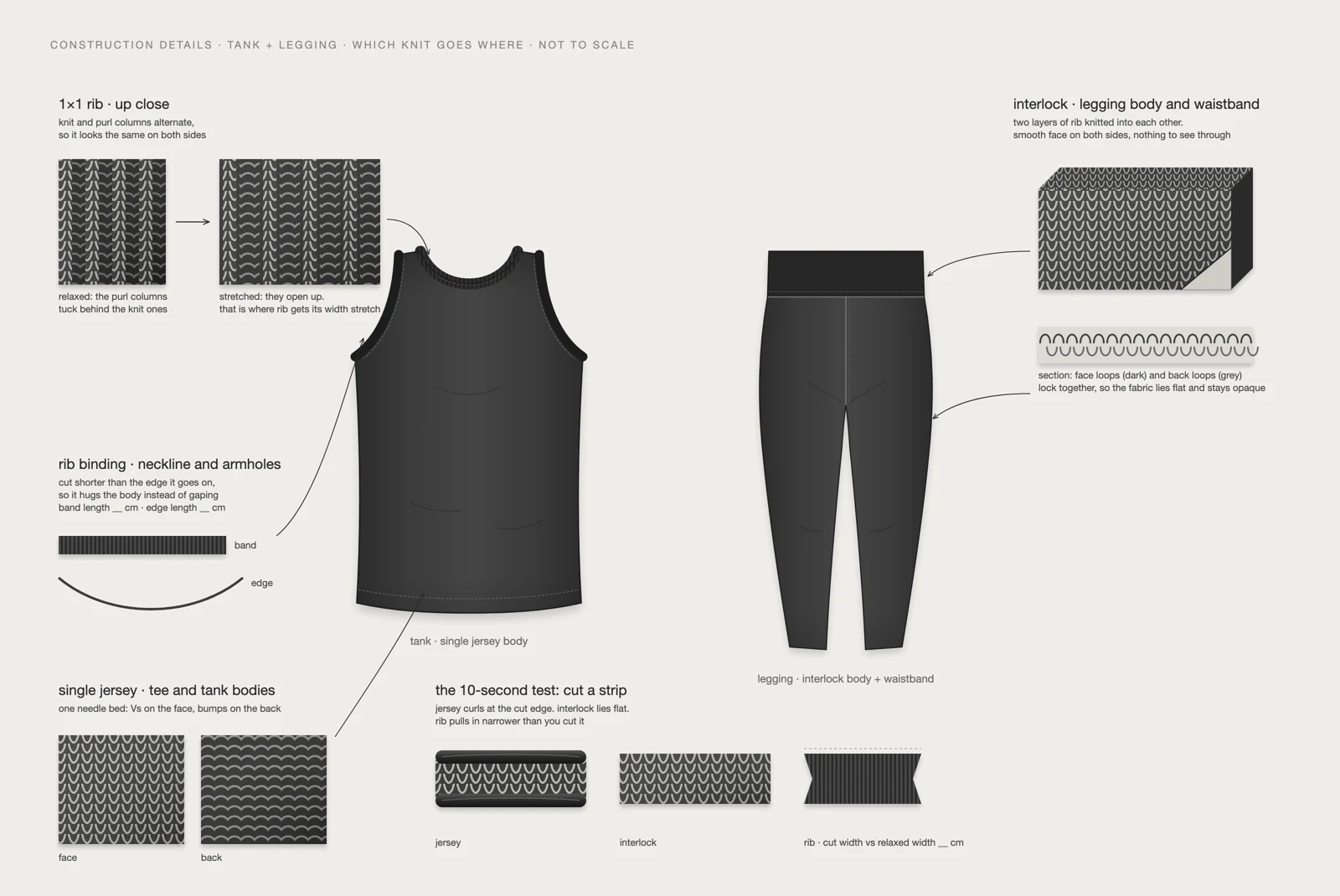
The tank body is usually single jersey. It’s light, it drapes, and on a top that sits a little away from the body nobody needs a second layer of loops. The neckline and the armholes are finished with a rib binding, cut shorter than the edge it goes on so it hugs the body instead of standing away from it. How you finish a neckline is a whole topic on its own; our guide to activewear necklines goes through the options.
The legging is interlock, or a similar double knit, from the waistband down. The waistband is often the same fabric doubled over, or a firmer double-face knit. Nothing on a legging gets a single jersey, because nothing on a legging is allowed to go see-through.
Honestly, that’s most ranges. A brand does not need ten different knits. A good jersey, a good interlock and a rib that matches them in colour will cover a lot of styles, and you get to know how each one behaves in the wash instead of guessing every season.
The 10-second test for telling them apart
If you have a swatch and no spec sheet, cut a strip about the width of your hand and look at it.
If the cut edges roll up, it’s single jersey. Look at both sides: Vs on one face, little bumps on the other. If the edges stay flat and both sides look smooth and the same, it’s interlock. If both sides look the same but the strip has pulled in narrower than you cut it, and it stretches a long way sideways, it’s rib.
That test won’t tell you the GSM or the fibre, but it will tell you which structure you’re holding, which is the first thing a factory needs to know.
Rib as the main fabric, not just the trim
Ribbed leggings, ribbed bras and ribbed tanks have been around in activewear for a while, and they look good. Here’s the thing, though. The same column structure that gives rib its stretch also opens up when it’s stretched. So a ribbed legging needs more weight behind it than a flat one, especially on the seat and knee, or it starts to show what’s underneath. Check it in a deep squat in daylight before you approve the sample, not just on a hanger.
A lot of “ribbed” activewear fabric is actually a textured knit with a fine rib look on the face rather than a true 1×1 rib. That’s fine. It just means you should ask what the structure is, because the stretch and the recovery will be different. Our fabric library has rib-textured performance knits from 135 to 280 GSM, plus a 225 GSM double-face knit made for waistbands and banding, if you want to feel the difference between them.
Questions brands ask about rib and interlock
Is interlock the same as double knit? Interlock is one kind of double knit. “Double knit” covers any fabric knitted on two sets of needles, and interlock is the most common one in activewear.
Can rib be used for a whole legging? Yes, but specify a heavier fabric than you would for a flat legging and do the squat test on the sample. Rib opens up as it stretches.
Why does my jersey keep curling? That’s what single jersey does at a cut edge. It’s handled in the sewing, with a binding, a hem or a band, not fixed in the fabric.
Developing a style in rib or interlock
New Dong Huang (NDH) has been making activewear in Dongyang, China since 1999. Samples take 7–10 days, so you can hold the real fabric, cut the strip, do the squat test and wash it before you commit.
If you’re not sure which knit a style should be in, send us a photo of the style and what it’s for. We’ll tell you what we’d use and why.