A legging can look perfect in the fitting room. Standing still, under nice lighting, in a mirror. Then someone does one deep squat in front of a window and, well. Now everyone knows.
Squat proof leggings are leggings that stay opaque when the fabric is stretched: in a deep squat, a forward fold or a lunge, nothing shows through at the seat or the knees. Whether a legging passes is decided long before anyone wears it, by the fabric, the colour, the fit and a few construction details. Here’s how it looks from the factory side, and why white is the colour everybody avoids.
Why leggings go see-through
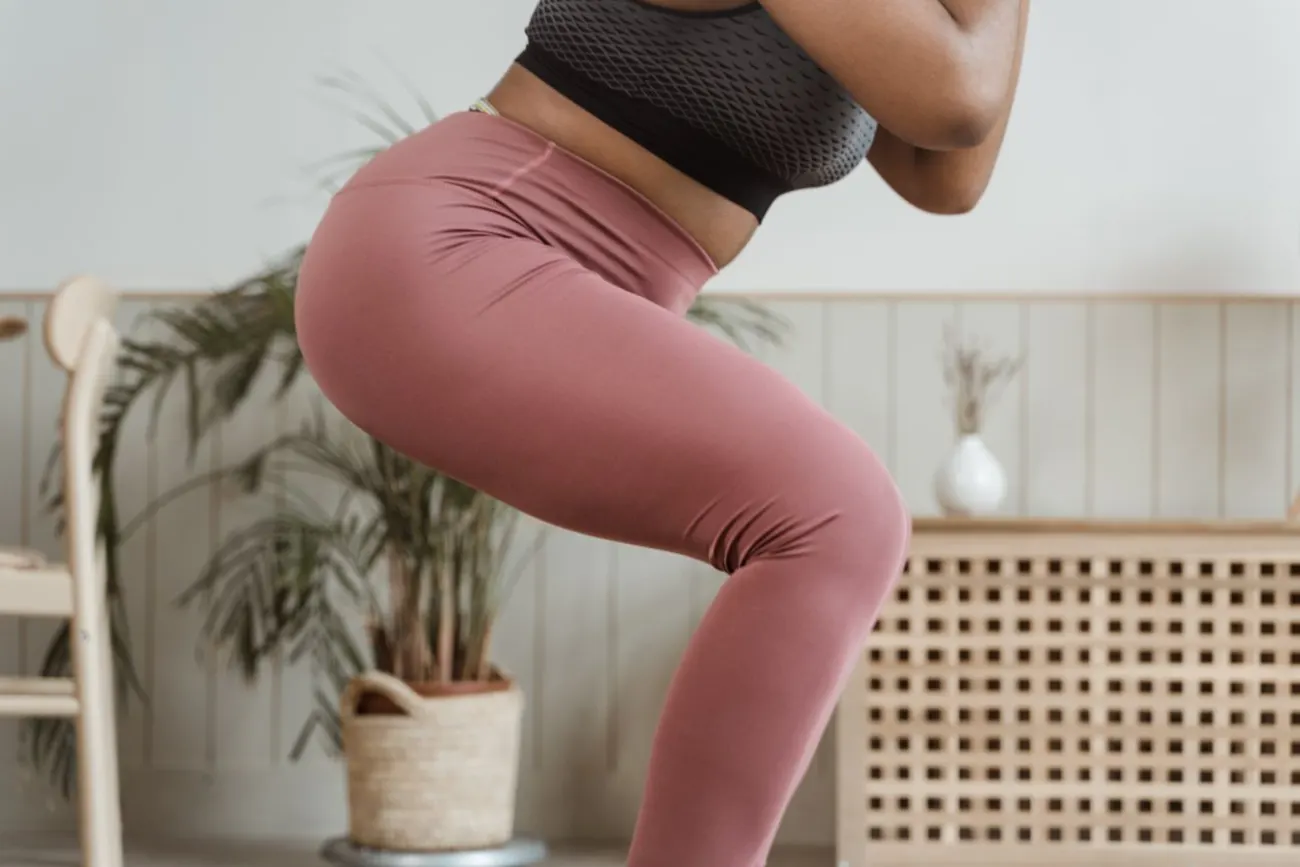
Knit fabric is made of loops. Stretch it and the loops open up, and light comes through the gaps. In a squat, the seat and the knees stretch far more than anywhere else on the legging. So that’s where it shows first.
That’s also why the fitting room lies to you. A fabric can look completely solid on the roll, or on a person standing still, and still go see-through the moment it’s stretched.
Fit makes it worse. A legging that’s too small, or a size that was graded a bit tight, stretches the fabric further than it was ever meant to go. Which is how a style can pass in the sample size and fail one size either side of it.
So what actually makes leggings squat proof?
Mostly density. A denser knit has smaller gaps to open up. Heavier fabric usually helps, but weight on its own isn’t the answer. A dense, lighter fabric can beat a loose, heavy one. (This is why we don’t trust a GSM number on its own. More on that in our article on GSM and fabric weight.)
Then structure. Double-knit structures like interlock have two layers of loops, so there’s always fabric behind every gap. That’s why they show up so often in women’s training leggings.
Then recovery. Good recovery pulls the knit closed again after it’s been stretched, so the legging doesn’t get more see-through every time it’s worn.
Then colour. Dark colours hide what’s behind the fabric. Light colours don’t, and that’s where most failures happen.
And finally construction. A crotch gusset keeps seams from all meeting at the point of most tension. A seat panel or a lining can go exactly where the stretch is highest.
The same rules apply to squat proof yoga pants and workout leggings. The difference is what customers will accept. A yoga legging is expected to feel lighter than a training tight. Lighter and opaque at the same time is harder, not easier.
Why you rarely see white leggings
Go look at a rack. Not many white leggings. That’s not a style decision. It’s a money decision.
White stretch fabric has no pigment to hide what’s underneath. Making it opaque means a much heavier fabric or a backing layer, and both cost stretch and cost money. White also shows sweat in real time, and sweat shows up later as returns. Then there’s matching it across production batches, which is harder than any other colour, because synthetic fibre yellows faster under heat, sweat and UV.
Higher returns. Higher QC cost. Shorter shelf life. The brands that skip white aren’t being boring about colour. They’re protecting their margins. If white matters to your range, plan for it at the very first fabric choice, not after the first sample comes back.
How to test for squat proof before bulk
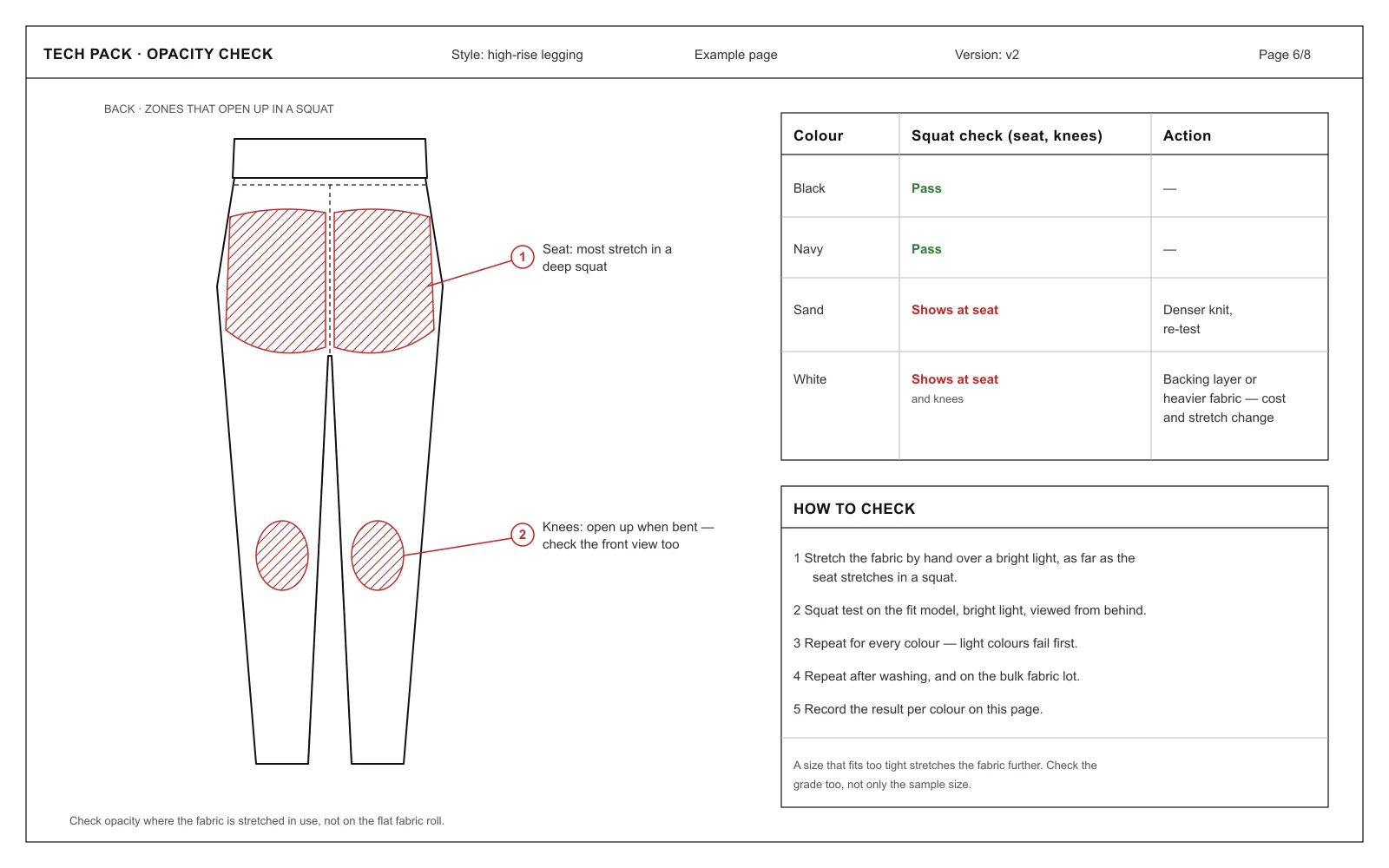
Start with your hands. Stretch the fabric over a bright light, about as far as the seat stretches in a squat, and see how much light gets through. Cheap, fast, and it rules out a lot.
Then put it on a fit model. Bright light, viewed from behind, full squat. Check the knees from the front while you’re there.
Test every colour. A pass in black tells you nothing about sand or white. Light colours fail first, every time.
Test after washing, and on the bulk lot. Washing changes things, and so can the difference between one fabric lot and the next.
And test the smallest and largest sizes, not only the sample size.
Write the result for each colour into the tech pack, so the requirement travels with the style. Our guide to what goes into a tech pack shows where it fits.
What the best squat proof leggings have in common
A dense knit with good recovery. A fit that doesn’t overstretch it. A gusset. A colour range that was tested one colour at a time. None of that is visible on a product page. All of it gets decided at development.
Developing squat proof leggings with us
We make leggings for activewear brands and check opacity at sampling. Tell us how your customers train, which colours you want and how you test, and we’ll test the same way. Our minimum is 500 pieces per colour per style. Send us your brief.
Originally shared on Instagram: @william.activewear.factory