Most neckline guides are written for dresses. Sweetheart, Queen Anne, bateau. Lovely words. Then someone wants one on a sports bra, and somebody has to work out how that edge survives being dragged over a sweaty head a few hundred times. That somebody is usually in a sample room.
Here is the short answer for activewear. The common types of necklines on activewear tops and sports bras are crew, scoop, square, V-neck or plunge, high neck and mock neck, plus halter and one-shoulder styles. Every neckline is really two decisions: the shape you draw, and the finish that holds the edge. The shape sets the look and the coverage. The finish decides whether the edge lies flat, stretches over the head and comes back after washing.
The second decision is the one that gets skipped, and it’s the one customers feel.
Neckline types at a glance
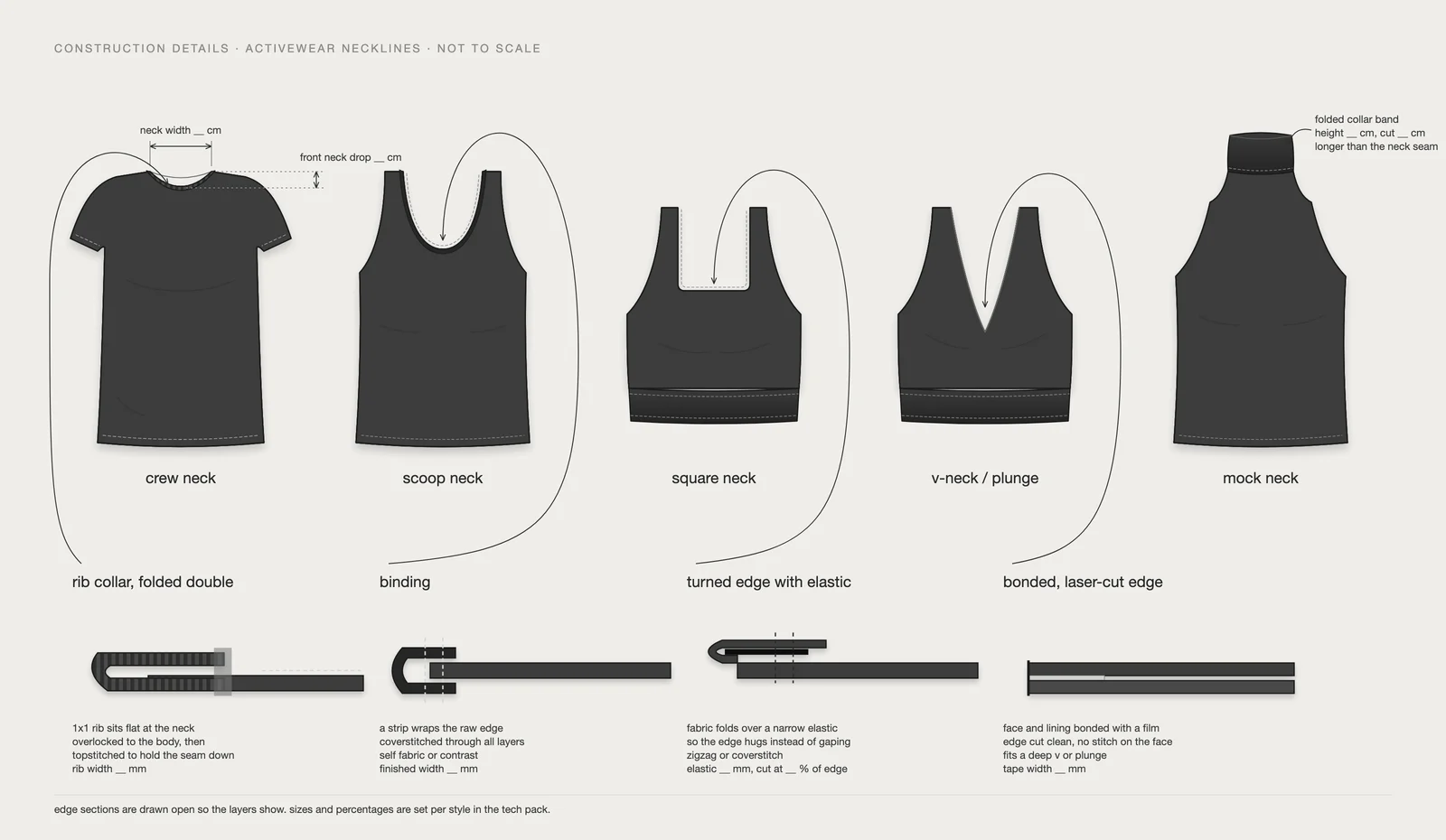
Five shapes cover most of what we see on activewear: crew and mock neck on tees and long sleeves, scoop on tanks, square and V on sports bras. Under them sit four finishes: a rib collar, binding, a turned edge with elastic, and a bonded edge. Mix and match within reason. A square neck with binding is possible. It is also a lot of work at the corners.
Crew neck: small opening, big job
The crew neck sits close around the base of the neck. It’s the neckline on most training tees and long sleeves, and it’s the hardest working one, because it is the smallest opening that still has to get over a head.
The usual finish is a rib collar. A strip of rib is folded double, overlocked to the body and topstitched so the seam stays down. 1×1 rib is the one that sits flat at a neck or cuff; we broke rib down by job in a recent post if you want the longer version.
Here’s the catch. Brands often spec the neck width and the front drop and stop there. Both are measured flat. What you actually care about is how far the opening stretches, and whether the collar comes back afterwards instead of going wavy. Put a minimum stretched neck opening in the spec. Then the fastest test of a crew neck sample is the obvious one: put it on and take it off a few times.
Scoop neck and U-neck
A scoop neck is wider and lower than a crew. It’s the default on tanks and on a lot of light and medium support bras, because it looks clean and gets out of the way.

Two finishes do most of the work here. Binding wraps a strip around the raw edge and is coverstitched through all the layers; it can be self fabric or a contrast colour, which makes it a design detail as much as a construction one. A turned edge folds the fabric over a narrow elastic, so the line looks plain from the outside but the edge hugs the body.
The deeper the scoop, the longer the edge, and a long curved edge on a stretch fabric wants to gape. That’s why the binding or the elastic is cut a little shorter than the edge it goes on. It pulls the neckline in. How much shorter is a number we set on the sample and write down, not something to guess in bulk.
Square neck
Square necks are a common pick on sports bras and fitted tanks. They look simple. The corners are not.
A binding has to turn ninety degrees twice, and on stretch fabric it tends to round off or pucker at each corner. A turned edge with elastic is easier to keep square, and so is a clean finish where the face fabric and the lining are sewn together and turned through, so no stitching shows on the outside. Either way, look at the corners first when the sample arrives, and again after a wash.
V-neck and plunge
On a tee, a V-neck needs a neat point. The rib or binding is mitred or overlapped at the bottom of the V, and that one small join is where the quality shows.
On a sports bra the V usually goes deeper and becomes a plunge. The neckline itself gives very little support, so the support has to come from somewhere else: the underband, the straps, an inner layer or cups. We cover those options in our guide to types of sports bras. Plunge bras often use a bonded, laser-cut edge: face and lining bonded with a film, cut clean, nothing stitched on the face. It looks smooth under a top and it doesn’t add bulk at the point.
High neck, mock neck, halter and one-shoulder
A high neck bra covers more of the chest and usually feels more secure, which is why it shows up on higher impact styles. The edge is normally a turned finish with elastic so it doesn’t stand away from the body when you lean forward.
A mock neck is a short folded collar band on a tee or a tank. The band is cut a little shorter than the neck seam it’s sewn to, so it stands up instead of flopping. It has the same head problem as a crew, only worse. Check the stretch before you check how it looks.
Halters and one-shoulder styles move the load. On a halter the strap around the neck carries the weight, so it needs elastic or a doubled strap. On a one-shoulder top the single edge across the chest is the one that slides, so it usually gets elastic with some grip.
What to put in the tech pack for a neckline
“Scoop, bound” can be made a dozen ways, and they won’t all fit the same. On the measurement page, give us neck width, front neck drop, back neck drop and a minimum stretched neck opening. On the construction page, say which finish goes on which edge, the finished width, the stitch type, and whether the binding or elastic is cut shorter than the edge (we’ll confirm the exact amount on the sample). If you’ve never written one of these pages, our tech pack guide walks through it.
Our own view: decide the finish at the same time you draw the shape, not after the first sample comes back. Samples take 7–10 days, so trying two finishes on the first round usually costs less than fixing one on the second. And if all you have is a photo of a neckline you like, send it. The first thing we’ll ask is what it looks like on the inside.
Developing tops and sports bras with us
New Dong Huang (NDH) has been making activewear in Dongyang, China since 1999: sports bras, training tops, tanks, leggings and the rest of a yoga and training range. Our minimum is 500 pieces per colour per style. If you’re working out a neckline, or a whole top, send us your sketch or tech pack and we’ll tell you how we’d finish it.