Shrinkage testing ensures activewear maintains its fit, performance, and durability after washing. Without proper testing, fabrics can shrink unevenly, distort seams, or lose their shape, leading to poor customer experiences and increased returns. Key points include:
- Dimensional stability helps garments retain their original size and functionality.
- Testing follows international standards like ISO 5077, AATCC 135, and ASTM D5278.
- Common shrinkage causes include relaxation shrinkage, felting, and hygroscopic shrinkage.
- Pre-treatment methods like heat setting and sanforization reduce shrinkage risks.
Accurate testing replicates consumer laundering conditions and uses controlled environments to measure fabric changes. Results guide manufacturers in improving fabric quality and providing care instructions.
Key Formula for Shrinkage:
Shrinkage Rate (%) = (Initial Length – Final Length) / Initial Length × 100
Fabric Shrinkage: Testing Procedures & How to Control It
sbb-itb-8dbc09a
International Testing Standards for Shrinkage
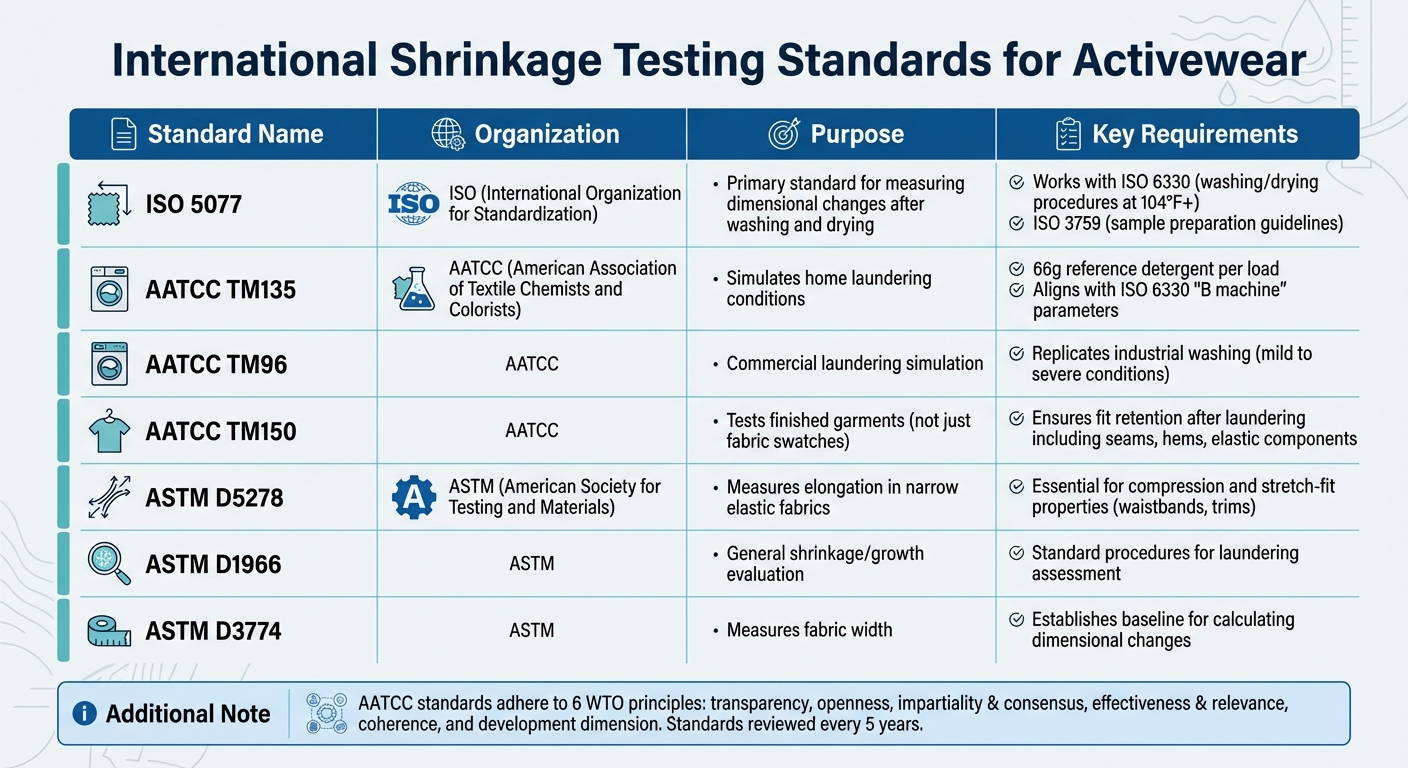
International Shrinkage Testing Standards Comparison for Activewear Fabrics
International testing standards play a key role in ensuring that activewear fabrics retain their size and shape after laundering. These standards provide reliable, repeatable methods to measure dimensional stability, which is crucial for performance apparel that needs to fit properly, even after multiple washes. Without these protocols, manufacturers would struggle to predict how garments behave over time or provide accurate care instructions to consumers.
Three main organizations oversee these testing standards: ISO (International Organization for Standardization), ASTM (American Society for Testing and Materials), and AATCC (American Association of Textile Chemists and Colorists). These groups set rigorous, scientific testing methods. AATCC standards, for example, adhere to six principles outlined by the World Trade Organization‘s Technical Barriers to Trade Committee: transparency, openness, impartiality and consensus, effectiveness and relevance, coherence, and development dimension. This ensures that test results are widely recognized and accepted across global markets. Together, these standards form the foundation for specialized testing protocols in activewear production.
ISO, ASTM, and AATCC Standards Explained
ISO 5077 is the primary international standard for measuring how fabrics change dimensionally after washing and drying. It works alongside ISO 6330, which defines specific washing and drying procedures – such as temperatures of 104°F or higher and precise mechanical agitation cycles. Before testing begins, ISO 3759 provides guidelines for preparing, marking, and measuring fabric samples.
AATCC TM135 simulates home laundering conditions to evaluate dimensional changes. This test uses standard reference detergents and specific agitation cycles to mimic real-world washing. For instance, it requires 66 g of reference detergent per load. AATCC TM135 aligns closely with ISO 6330’s "B machine" parameters. On the other hand, AATCC TM96 focuses on commercial laundering, replicating industrial washing conditions ranging from mild to severe.
For activewear featuring elastic fibers like spandex or elastane, ASTM D5278 measures elongation in narrow elastic fabrics, which is essential for assessing compression and stretch-fit properties in elements like waistbands and trims. ASTM D1966 outlines general procedures for evaluating shrinkage or growth in textiles after laundering, while ASTM D3774 measures fabric width to establish an accurate baseline for calculating dimensional changes. Together, these standards provide a comprehensive framework for testing activewear fabrics.
How Standards Differ for Activewear Applications
AATCC TM150 focuses on testing finished garments, rather than just fabric swatches, to ensure fit retention after laundering. This distinction is important because garment construction – such as seams, hems, and elastic components – can behave differently than raw fabric.
Activewear testing also considers synthetic fibers like polyester, which are resistant to shrinkage but sensitive to heat during drying. This sensitivity can impact garment performance. Unlike natural fibers such as cotton or linen, which tend to shrink more, synthetic fabrics require careful testing to avoid skewed results caused by heat exposure. Additionally, knitted fabrics, commonly used in activewear for their stretch properties, tend to shrink more than woven fabrics.
Testing for activewear often includes evaluating functional properties alongside shrinkage. For example, AATCC TM195 (Liquid Moisture Management) and AATCC TM197/198 (Wicking) ensure that laundering does not compromise a fabric’s ability to wick moisture or remain breathable. Similarly, ASTM D6797 assesses bursting strength in conjunction with shrinkage to confirm that knitted fabrics maintain their structural integrity after repeated washing.
Standard Shrinkage Testing Methods and Procedures
Home Laundering and Dimensional Stability Tests
Home laundering tests are designed to mimic the typical washing conditions consumers use for activewear. The AATCC 135 standard is a go-to method for this, utilizing a top-load washing machine with a set amount of standard detergent to replicate real-life scenarios. The process involves marking fabric samples with indelible ink at specific reference points before washing them. Afterward, samples are dried using different methods to observe how each drying condition impacts the fabric’s dimensional stability.
Similarly, the ISO 6330 standard replicates household washing but specifies hot water temperatures of 40°C (104°F) or higher. It also incorporates controlled mechanical agitation and specific drying cycles to simulate realistic conditions. To ensure accurate results, fabric samples are conditioned in a controlled atmosphere before testing. This step helps eliminate moisture-related inconsistencies in measurements. Beyond these methods, additional tests are used to evaluate shrinkage under varying conditions.
Water Immersion and Mechanical Treatment Methods
While home laundering tests focus on everyday washing scenarios, other methods explore how fabrics respond to water and mechanical stress in controlled environments. Water immersion tests are particularly effective for measuring hygroscopic shrinkage – this occurs when fibers absorb moisture without experiencing much mechanical stress. In these tests, fabric samples are submerged in water mixed with a mild detergent and agitated for about 10 minutes. This approach is especially relevant for delicate performance fabrics.
On the other hand, mechanical treatment methods are designed to assess relaxation shrinkage, which happens when the manufacturing tensions in fibers are released during washing. For activewear that includes elastane, tests like ASTM D5278 are used to measure how static loads impact the fabric’s stretch and recovery properties. This is crucial for ensuring the garment maintains its compression fit and overall performance.
Equipment and Tools Used in Shrinkage Testing
Accurate shrinkage testing requires specialized tools and equipment to ensure consistent results. Automatic washing machines – such as ISO 6330 Type B models or AATCC-compliant top-loaders – are standard for these tests. Tumble dryers are used for drying, while fabrics are marked with indelible ink and measured with calibrated rulers or shrinkage scales.
Fabric conditioning chambers play a key role by maintaining controlled temperature and humidity levels. This ensures the samples are stabilized both before and after laundering. Ballast fabrics are used during washing to provide consistent mechanical agitation, while the AATCC Standard Reference Detergent replaces commercial detergents to maintain uniformity across tests. These tools and procedures help ensure activewear retains its intended fit, functionality, and performance quality.
How to Calculate Shrinkage and Acceptable Limits
Formulas for Calculating Shrinkage Percentage
To calculate fabric shrinkage, use this formula:
Shrinkage Rate (%) = (Initial Length – Final Length) / Initial Length × 100.
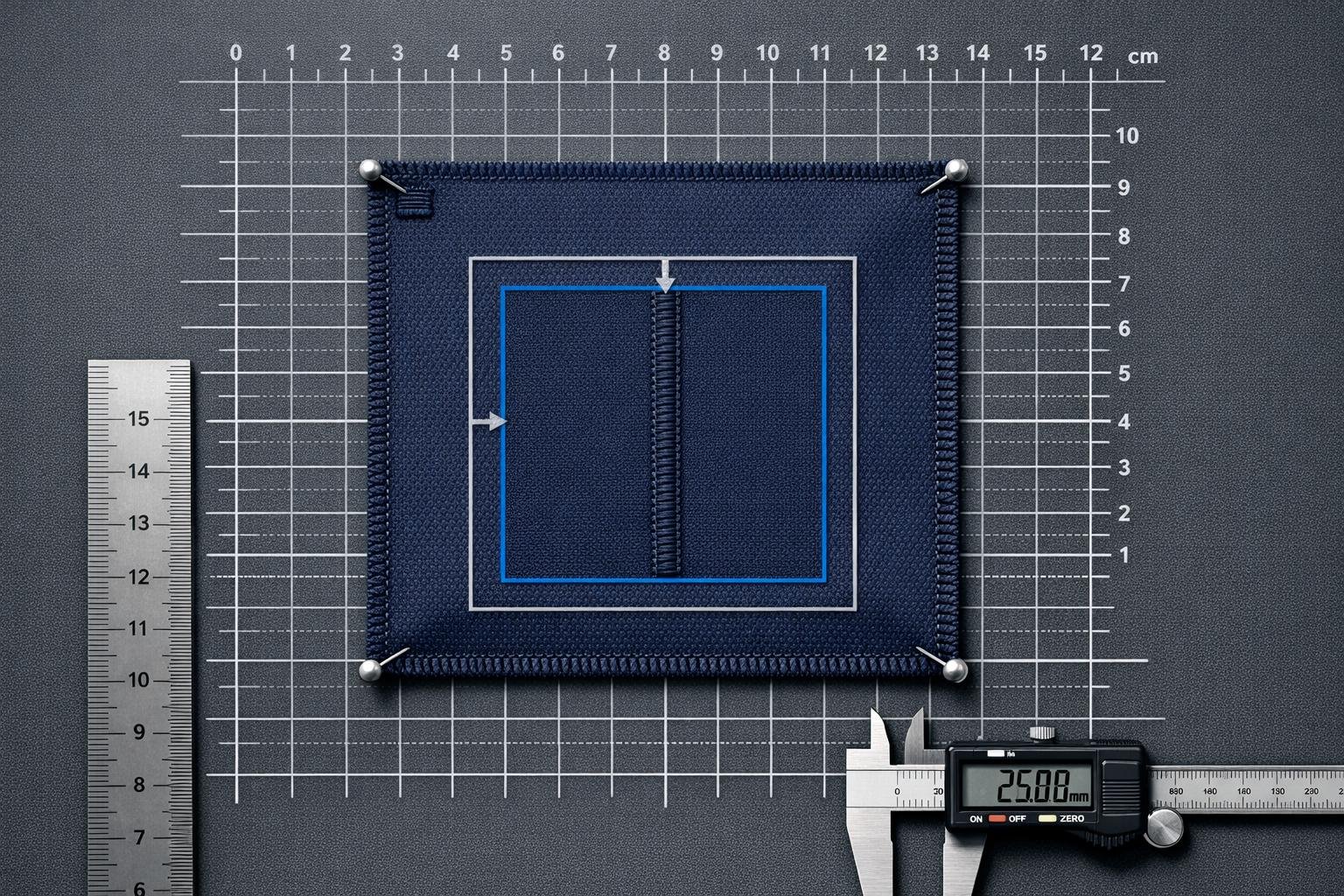
A positive result means the fabric has shrunk, while a negative result indicates it has expanded. Start by cutting fabric samples to 500 mm × 500 mm (about 19.7 in × 19.7 in) in both warp and weft directions. Mark reference points 300 mm (approximately 11.8 in) apart using wash-fast indelible ink or stitching. The samples should be conditioned in standard atmospheric conditions before undergoing a controlled laundering process. After a 24-hour post-conditioning period, measure the final distance between the reference points and apply the formula.
For reliable results, repeat the test at least three times to account for the natural variability of the fabric. Averaging these results ensures more accurate data, which can then be used to adjust garment patterns if needed. These calculations are essential for determining acceptable shrinkage thresholds for specific activewear fabrics.
Acceptable Shrinkage Limits for Activewear Fabrics
The acceptable shrinkage limits depend on factors like fiber type, fabric construction, and brand requirements. Natural fibers such as cotton and wool tend to shrink more because they absorb moisture, while synthetic fibers like polyester and nylon are more stable unless exposed to high heat. Fabric construction also matters – tightly woven fabrics shrink less compared to loosely knit fabrics, which are prone to relaxation shrinkage as manufacturing tensions release during washing.
For stretch fabrics, commonly found in performance leggings and compression wear, standards like ASTM D5278 help evaluate elongation and dimensional stability. Since acceptable shrinkage limits can vary by garment type, performance leggings often have stricter tolerances compared to casual shirts. Sourcing managers should always confirm the specific shrinkage requirements outlined by their customers to ensure compliance.
Factors That Affect Shrinkage in Activewear Fabrics
How Fiber Type and Fabric Construction Affect Shrinkage
The type of fiber used in a fabric has a major impact on shrinkage. Natural fibers like cotton tend to shrink between 3% and 5%, though untreated cotton can shrink up to 10%. Wool is even more prone to shrinkage, with rates ranging from 10% to 20% due to felting, while viscose can shrink as much as 10% because it absorbs a lot of water [12, 13, 15]. On the other hand, synthetic fibers like polyester and nylon are hydrophobic, meaning they resist moisture and typically shrink less than 1% [12, 13]. These synthetic fibers are thermoplastic, so manufacturers can heat-set them at temperatures between 356°F and 392°F (180°C to 200°C) during production to lock in their structure and prevent further shrinkage. Fiber blends, such as a 65:35 cotton-polyester mix, are a practical way to lower shrinkage in cotton fabrics, reducing it to around 1% to 2%.
Fabric construction also matters. Knitted fabrics are more prone to shrinkage than woven ones because their looped structure relaxes after being stretched. Woven fabrics generally shrink up to 3%, while knitted fabrics can shrink up to 5% [13, 14]. Additionally, fabrics with a higher density provide better dimensional stability. Among knitted fabrics, plain knits are more likely to change shape after washing compared to ribbed knits [16, 17]. These characteristics set the foundation for how washing and other treatments influence fabric behavior.
Effects of Laundering Cycles and Heat Exposure
Washing and drying cycles significantly affect fabric dimensions over time. Cold or lukewarm water and air drying are gentler on fabrics, helping to limit shrinkage, while tumble drying causes the most shrinkage due to mechanical stress [12, 13, 14, 15]. Over time, fabrics tend to stabilize, as manufacturing tensions are fully released after about 30 minutes of washing. For activewear, testing shrinkage after five washes instead of just one ensures that any residual tensions are accounted for.
Even though synthetic fibers resist shrinkage, they are not immune to heat damage. Exposure to temperatures above their heat-set threshold during laundering can lead to permanent changes in size and shape.
Manufacturing Tensions and Pre-Treatment Techniques
Shrinkage during the first few washes often stems from manufacturing tensions. Fabrics are kept under constant tension during processes like weaving, knitting, and dyeing. When these tensions are released during laundering, the fabric relaxes to its natural state, leading to what’s known as relaxation shrinkage [18, 1]. If these tensions are not addressed through pre-treatment, the fabric may shrink significantly during its initial washes.
Different pre-treatment methods are used depending on the fiber type. Synthetic fibers like polyester and nylon benefit from heat setting, where thermal energy stabilizes their structure. For cotton and cotton blends, processes like mercerization enhance dimensional stability, while sanforization – a mechanical pre-shrinking method – can reduce cotton shrinkage to less than 1%. It’s crucial for sourcing managers to ensure fabrics are properly pre-shrunk and that heat-setting parameters are tailored to the specific fiber blend to maintain long-term shape and size [1, 18].
Conclusion and Best Practices for Shrinkage Testing
Key Points on Shrinkage Testing Standards
Shrinkage testing plays a key role in maintaining the quality of activewear. Following established protocols is essential – use AATCC 135 for U.S. home laundering and ISO 5077/6330 for international standards. For knitted and elastic fabrics, include ASTM D5278 to evaluate elongation and stability. Testing should replicate real-world consumer use, reflecting the specific washing and drying conditions garments will face. Before testing, condition samples for 24 hours at 68°F ± 4°F (20°C ± 2°C) and 65% ± 4% relative humidity. Shrinkage typically results from manufacturing tension release, natural fiber felting, and moisture absorption.
With these points in mind, sourcing managers and brands can adopt practical approaches to ensure consistent custom leggings quality.
Practical Tips for Sourcing Managers and Brands
Adhering to international standards like ISO and AATCC ensures reliable shrinkage testing. Stay updated with the latest methods since AATCC standards are reviewed every five years to account for advancements in washing machine technology. Follow standardized guidelines for sample dimensions and markings, and evaluate the effects of high-heat drying on synthetic fibers, which are particularly prone to thermal deformation. If lab results show inconsistencies, compare samples from the same lot to eliminate bias. For fabrics with high shrinkage tendencies, consider pre-shrunk treatments or sanforization during production to reduce dimensional changes in finished garments. Use shrinkage test data to create accurate care labels, helping to lower customer complaints and product returns.
FAQs
Which shrinkage test standard should I use for my activewear?
When it comes to activewear, maintaining fabric quality and performance is crucial. Two widely recognized standards for testing shrinkage are:
- ISO 3759: This standard assesses dimensional changes in fabric after washing and drying, helping ensure the material maintains its shape and size.
- ASTM D6207: This test evaluates fabric stability under varying humidity and temperature conditions, ensuring reliability in different environments.
Both standards are essential tools in the industry to guarantee the durability and performance of activewear.
How many wash cycles should shrinkage testing include?
Shrinkage testing usually involves a minimum of five wash cycles to accurately evaluate a fabric’s dimensional stability. This aligns with standards like AATCC 96, EN ISO 6330, and ASTM D1966, which outline procedures for assessing how fabrics perform under repeated laundering conditions.
What is an acceptable shrinkage percentage for leggings and stretch fabrics?
For leggings and stretch fabrics, a shrinkage percentage of about 2–3% is generally considered acceptable. This range ensures the material retains its shape and size after washing and during everyday wear. Keeping shrinkage within these limits is key to maintaining the fit and overall quality of performance apparel.