When creating activewear, the choice between heat sealing and stitching impacts durability, comfort, and cost. Here’s a quick breakdown:
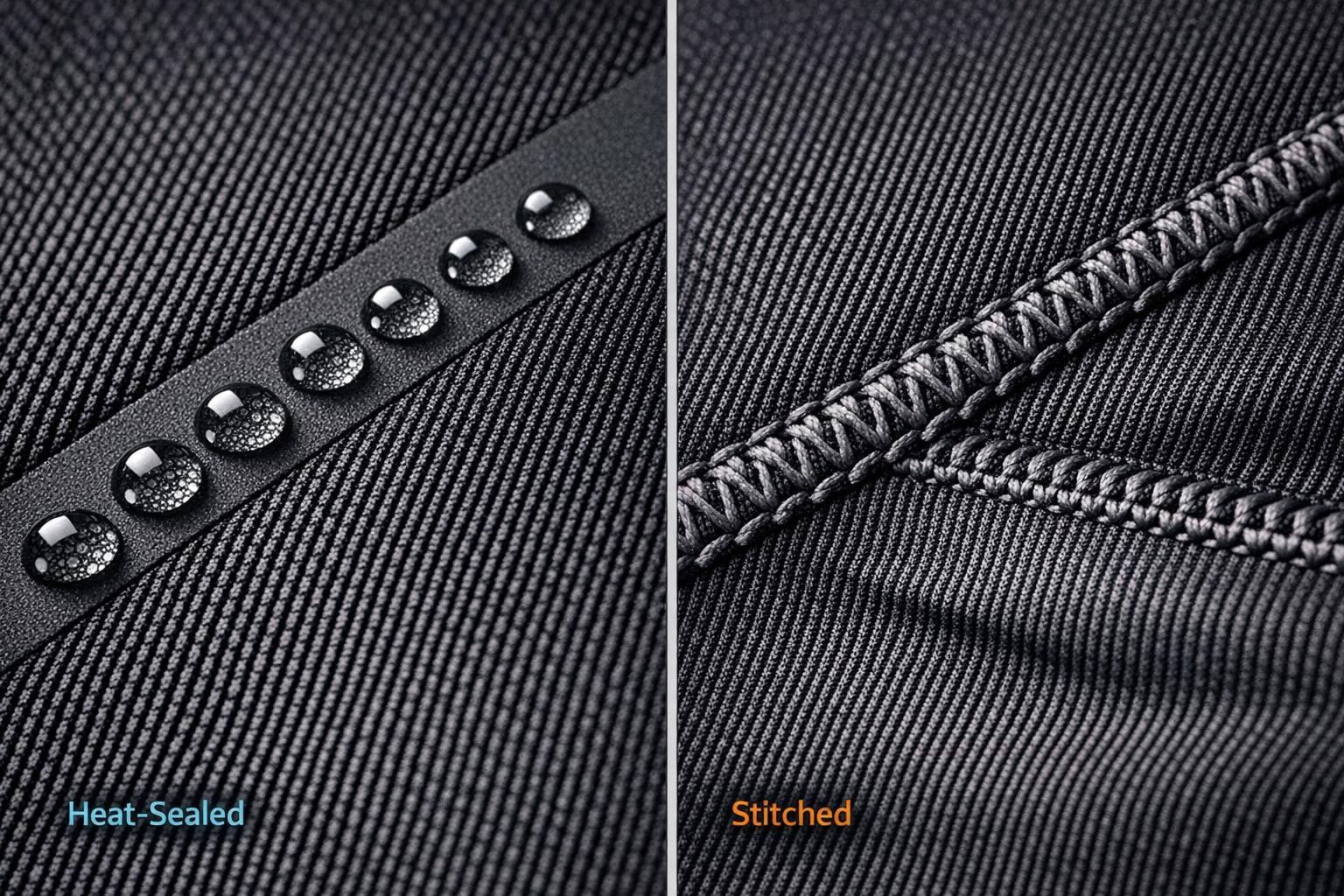
- Heat Sealing: Uses heat-activated adhesives to join fabrics, offering superior waterproofing, reduced weight, and a smooth finish. Ideal for sleek, next-to-skin garments like yoga leggings but costs 2x more than stitching.
- Stitching: Relies on needle and thread, providing strong seams, better stretch, and lower costs. Works well for high-stress areas like waistbands but may compromise waterproofing.
Quick Comparison:
| Feature | Heat Sealing | Stitching |
|---|---|---|
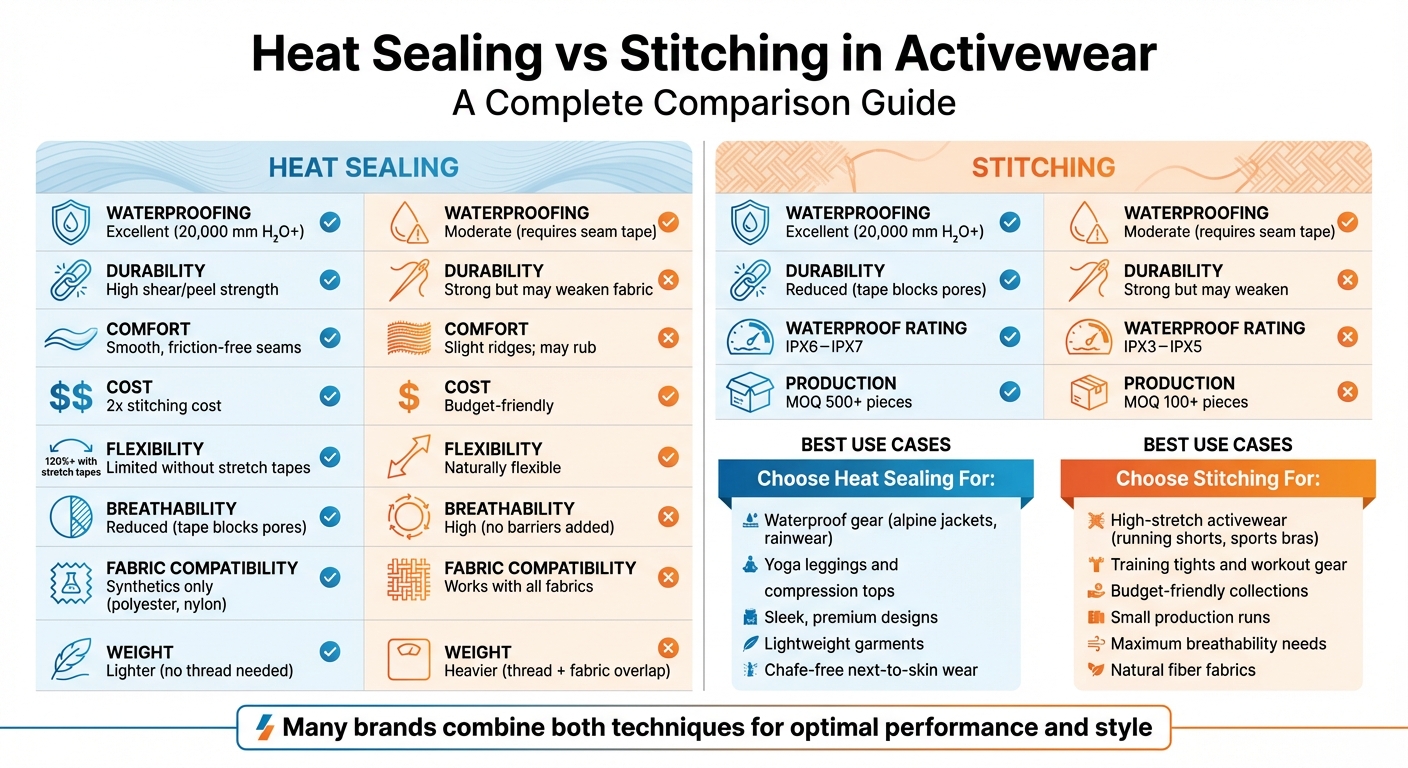
| Waterproofing | Excellent (20,000 mm H₂O+) | Moderate (requires seam tape) |
| Durability | High shear/peel strength | Strong but may weaken fabric |
| Comfort | Smooth, friction-free seams | Slight ridges; may rub |
| Cost | 2x stitching cost | Budget-friendly |
| Flexibility | Limited without stretch tapes | Naturally flexible |
| Fabric Types | Synthetics only | Works with all fabrics |
Key Takeaway:
Choose heat sealing for waterproof, lightweight, and premium designs. Opt for stitching for stretch, durability, and cost efficiency. Many brands combine both techniques for optimal performance and style.
Heat Sealing vs Stitching in Activewear: Complete Comparison Guide
Durability: Heat Sealing vs Stitching
When it comes to activewear, how seams are constructed plays a huge role in how long the garment lasts. From resisting wear and tear to surviving multiple washes, both heat sealing and stitching have their strengths, depending on the application.
Seam Strength and Longevity
Stitched seams are often the go-to for heavy-duty use. Techniques like flatlock or overlock stitching create loops that distribute tension evenly, making them ideal for areas under constant strain, like waistbands or underarms. However, there’s a trade-off – every needle puncture slightly weakens the fabric’s overall integrity.
Heat-sealed seams take a different route. By fusing fabric layers together, they avoid the punctures that come with stitching. This results in seams with higher shear and peel strength. For instance, while ultrasonic welding might yield lower seam strength than traditional sewing, laser welding can produce seams robust enough for demanding uses like airbags. Industry benchmarks for heat-sealed seams include achieving at least 80% of the fabric’s strength (ISO 13935-2) and a peel strength of over 10 N/25 mm (ASTM D1876).
For activewear prone to high friction, such as running shorts, stitched seams often perform better because they can endure repetitive movement more effectively.
Now, let’s see how these seam types hold up under washing and physical wear.
Resistance to Washing and Abrasion
When it comes to washing and abrasion, the differences become clear. Heat-seal tapes, especially three-layer varieties, are designed to handle industrial washing at temperatures above 167°F (75°C). While strong detergents and heat can weaken adhesives over time, the outer protective layer in three-layer tapes boosts their resistance to abrasion. This makes them a solid choice for workwear or gear that faces tough conditions.
Stitched seams, on the other hand, are naturally rugged against rough surfaces, though the threads can eventually fray. Heat-sealed seams, while offering a sleek and smooth finish, are more prone to failure under sharp abrasion.
The durability expectations vary across private label leggings manufacturers. Some brands only require garments to survive five wash cycles, while others demand durability over 10 to 25 cycles for high-performance outdoor wear. For garments that endure frequent or industrial laundering, opting for three-layer heat-seal tapes instead of two-layer ones can help prevent adhesive breakdown.
These factors also tie into how well a garment performs in waterproof and high-stress scenarios.
Waterproofing and High-Stress Applications
Seam durability directly affects waterproofing and how well garments handle tough conditions.
Heat-sealed seams shine in waterproofing. Because they eliminate needle holes, they create a continuous, leak-proof barrier capable of withstanding water pressures exceeding 20,000 mm H₂O. This is where they outperform stitched seams, as needle holes in stitching become natural leak points, allowing water to seep through – a process called "wicking".
Here’s a quick comparison of the two methods:
| Feature | Heat-Sealed Seams | Stitched Seams |
|---|---|---|
| Waterproof Rating | Excellent (IPX6–IPX7) | Moderate (IPX3–IPX5) |
| Needle Holes | None (fused barrier) | Present (natural leak points) |
| Seam Strength | High shear/peel strength; depends on method | Strong mechanical strength; weakened by perforations |
| Abrasion Resistance | High with 3-layer tape; may puncture | Durable, though threads may fray |
| Repairability | Requires specialized tools | Easily repairable with needle and thread |
For garments like alpine jackets or marine apparel, where complete waterproofing is critical, sealing all seams is a must. On the other hand, for casual rainwear, it might be enough to seal key areas like hoods and shoulders. Meanwhile, high-stress parts of a garment, such as harnesses or pockets, often benefit from the mechanical reliability of reinforced stitching.
sbb-itb-8dbc09a
Aesthetics: Heat Sealing vs Stitching
When it comes to activewear, how seams look is just as important as how they perform. The choice between heat sealing and stitching plays a big role in shaping a garment’s visual identity – whether it’s a sleek, modern vibe or a bold, athletic feel.
Smooth and Minimal Finish
Heat sealing creates a flat, almost invisible seam that blends seamlessly with the fabric. There’s no thread, no bulky ridges, and no rough edges – just a clean, polished connection that lets the material itself stand out. This "stitch-free" approach has become a hallmark of high-end activewear, embodying a subtle elegance often referred to as "quiet luxury".
"Bonded seams allow designers to create truly modern garments where the technology is invisible, letting the fabric and fit shine. This technique is the essence of ‘quiet luxury’."
- Emma, Activewear Industry Veteran
Brands like Lululemon and Alo Yoga use this technique to elevate their designs. Lululemon’s Align leggings, for example, offer a seamless, friction-free experience, while Alo Yoga combines laser-cut hems with bonded seams to achieve a refined, intentional aesthetic. Some even compare this minimalist design approach to the sleekness of Apple products.
Heat sealing also works well with laser cutting, enabling intricate details like cut-outs or lace-like designs that won’t fray. While laser cutting can increase production costs by 15–20%, the polished result often justifies the expense. Additionally, heat-sealable tapes come in printable or color-matched options, allowing for subtle branding or Pantone-matched seams without sacrificing the streamlined look.
Visible and Customizable Appearance
In contrast, stitched seams are meant to be seen. Flatlock stitching, for instance, creates a textured "ladder" pattern that has become a recognizable feature of high-performance athletic wear.
"The distinct visual look of a flatlock stitch has also become an aesthetic signature of high-performance athletic apparel. Customers recognize it and associate it with quality."
- Emma, Activewear Industry Veteran
Stitching offers endless customization options. Designers can play with thread colors and stitch patterns to highlight seams, add visual interest, or reinforce brand identity. While stitched seams may introduce slight ridges or bulk, this texture often signals durability and craftsmanship. Another advantage? Stitching is budget-friendly and works well for smaller production runs, with minimum orders starting at around 100 pieces.
These aesthetic differences help designers decide which method best fits their garment’s style and purpose.
Design Applications in Activewear
The choice between heat sealing and stitching isn’t just about looks – it also impacts how the garment performs. Heat sealing is ideal for sleek, skin-tight designs like yoga leggings, compression bras, or base layers, where a seamless finish is key to comfort and function.
Stitching, on the other hand, complements athletic and outdoor styles. Flatlock or overlock seams add a rugged, sporty edge to running shorts, training tops, and outdoor jackets, signaling performance and reliability.
A growing trend in activewear is hybrid construction, where both techniques are used strategically. For instance, a running jacket might feature bonded seams on the shoulders and hood for waterproofing, while stitched seams on the side panels allow for flexibility and breathability.
| Feature | Heat-Sealed / Bonded Seams | Stitched Seams (Flatlock) |
|---|---|---|
| Visual Profile | Smooth, flat, nearly invisible | Visible, textured "ladder" look |
| Design Style | Minimalist, "quiet luxury", modern | Athletic, rugged, customizable |
| Bulk | Zero bulk; no fabric folds | Slight ridge or texture |
| Customization | Limited to tape colors/prints | High; via thread colors and patterns |
| Edge Finish | Often paired with laser-cut sharp edges | Typically features folded or overlocked edges |
| Cost | About 2× that of stitching | Most budget-friendly |
Performance: Heat Sealing vs Stitching
When it comes to activewear, seam construction plays a key role in performance, alongside durability and appearance. The choice between heat sealing and stitching can significantly impact how a garment performs during workouts, outdoor activities, or even daily wear. Each method offers distinct strengths depending on the intended use and conditions.
Elasticity and Flexibility
Stitched seams naturally excel in stretchability. Flatlock stitching, in particular, creates thread loops that move with the fabric, making it a top choice for activities like running or CrossFit, where garments endure constant stretching. On the other hand, heat-sealed seams, while traditionally less flexible, have evolved with the introduction of specialized "stretch tapes" that offer elongation of over 120%. This advancement makes bonded seams a strong contender for yoga leggings and compression gear, delivering a smooth, second-skin fit. However, these seams may not match the tensile strength of reinforced stitching in heavy-duty scenarios.
"The flexible and stretchy nature of our adhesive tapes produces a bond that is more adaptable than sewing thread with a more resistant ‘break point’."
For garments that demand extreme flexibility, such as running shorts or training tights, flatlock stitching remains the go-to option due to its proven ability to handle intense, repetitive stretching. These differences in flexibility directly affect how comfortable the garment feels during high-movement activities.
Breathability and Comfort
Comfort and breathability are also influenced by seam construction. Heat-sealed seams lay flat against the skin, eliminating friction and making them ideal for tight-fitting garments. Designers often use narrow tapes (4–8 mm) to minimize the impact on breathability.
Stitched seams, by contrast, do not obstruct the fabric’s natural airflow, ensuring maximum breathability – a big plus for activities that lead to heavy sweating. However, the slight texture of stitched seams can sometimes cause minor rubbing during prolonged workouts.
Waterproofing and Outdoor Performance
Waterproofing is another area where seam type makes a significant difference. For outdoor gear, heat-sealed seams are the clear choice. They deliver exceptional waterproofing (IPX6–IPX7 ratings) and are less prone to issues like tape lifting, which can allow water to seep in under pressure. Stitched seams, even when reinforced with tape, generally achieve moderate waterproofing levels (IPX3–IPX5).
In extreme conditions, heat-sealed seams are essential. For lighter rain or urban wear, sealing only key areas like shoulders, hoods, and zippers can offer a practical balance between waterproofing and breathability.
| Feature | Heat-Sealed Seams | Stitched Seams |
|---|---|---|
| Stretch | 120%+ with stretch tapes | Naturally flexible; great for high movement |
| Chafe-Free | Smooth, frictionless surface | Slight texture; may rub during extended wear |
| Breathability | Reduced (tape blocks pores) | High (no barriers added) |
| Waterproofing | Excellent (IPX6–IPX7) | Moderate (IPX3–IPX5) |
| Weight | Lighter; no thread needed | Heavier due to thread and fabric overlap |
When to Choose Heat Sealing vs Stitching
Deciding between heat sealing and stitching comes down to the garment’s purpose, performance needs, and fabric type. Each method has its strengths, making it suitable for specific applications.
Heat Sealing: Best for Waterproof and Sleek Designs
Heat sealing is the go-to option when waterproofing is non-negotiable. A staggering 82% of waterproofing failures are caused by poorly sealed seams. By eliminating needle holes, heat-sealed seams can achieve waterproof ratings exceeding 20,000 mm H₂O. This makes them ideal for alpine jackets, rainwear, and other outdoor gear where staying dry is critical. Plus, heat sealing creates a smooth, friction-free finish, which is perfect for tight-fitting garments like yoga leggings and compression tops.
Brands like Lululemon use bonding and laser cutting in their "Align" leggings to ensure a chafe-free experience. Similarly, Alo Yoga incorporates laser-cut hems and bonded seams in premium tops to prevent snags and maintain a consistent fit.
That said, heat sealing comes with higher production costs – about twice as much as stitching – and requires minimum order quantities (MOQs) of 500+ pieces compared to stitching’s 100+ pieces. Adding laser cutting increases costs by another 15–20%. For casual rainwear, where full waterproofing isn’t necessary, sealing only key areas like shoulders, hoods, and zippers balances performance with cost.
When durability and flexibility take priority, stitching becomes the better choice.
Stitching: Ideal for Stretch and Durability
Stitching is unmatched when it comes to garments that need to endure high-impact activities and repeated stretching. Activewear like running shorts, sports bras, and training tights benefits from the strength and elasticity of stitched seams. Flatlock stitching, in particular, moves seamlessly with the fabric during intense activities.
For garments exposed to constant stress – like the elastic bands in sports bras or the waistbands of compression leggings – reinforced stitching offers more reliable performance than heat sealing. Stitching is also more cost-effective, with lower production costs and smaller MOQs, making it a smart choice for smaller brands, test runs, or budget-friendly collections. Additionally, stitching works with almost any fabric, offering greater versatility compared to heat sealing.
How Fabric Choice Influences Your Decision
Fabric compatibility is another key factor. Heat sealing works only with synthetic fabrics that have thermoplastic properties, such as polyester, nylon, or laminates like PU, PVC, TPU, or ePTFE. These fabrics must endure sealing temperatures between 248°F and 302°F (120°C–150°C) without deforming or damaging coatings. Natural fibers like cotton or wool can’t be heat sealed unless pre-laminated with thermoplastic film or paired with special adhesive tapes. For eco-conscious brands, co-PES adhesive tapes on 100% polyester fabrics allow for monomaterial recycling.
Stitching, on the other hand, works with a wider range of textiles, including natural fibers, synthetic blends, and even fabrics with up to 40% natural fiber content when ultrasonic welding is used.
| Decision Factor | Choose Heat Sealing | Choose Stitching |
|---|---|---|
| Primary Need | Waterproofing, ultralight design, comfort | High stretch, durability, cost efficiency |
| Ideal Garments | Rain jackets, alpine gear, yoga wear | Running shorts, sports bras, activewear |
| Fabric Types | Synthetics (polyester, nylon) w/ laminates | All textiles (natural, synthetic, blends) |
| Production Cost | 2× stitching cost; +15–20% w/ laser cutting | Budget-friendly |
| MOQ | 500+ pieces | 100+ pieces |
At New Dong Huang Garment Co., Ltd., we combine the strengths of both heat sealing and stitching to create activewear that meets the highest standards of performance, durability, and comfort. Every garment is tailored to the specific needs of your designs, ensuring functionality without compromising on style.
Conclusion
Choosing between heat sealing and stitching ultimately hinges on your garment’s purpose and design priorities. Heat sealing is the preferred option when waterproofing, comfort, and a sleek look are critical. By eliminating needle holes – a common weak point for waterproofing – it can achieve water resistance levels exceeding 20,000 mm H₂O. Plus, its smooth, chafe-free finish makes it a standout choice for activewear like yoga leggings and compression garments. That said, this method tends to be more expensive and works best with synthetic fabrics that can endure high temperatures.
On the other hand, stitching remains a staple for garments that require high stretch, cost-efficiency, or exceptional mechanical strength. It’s compatible with both natural and synthetic fabrics, offers lower production costs, and holds up well under repeated high-impact use. However, visible seams may lead to chafing in snug-fitting designs.
The type of fabric you select also plays a major role. Synthetics like polyester and nylon pair well with heat sealing, while natural fibers such as cotton typically require stitching unless pre-treated with a thermoplastic film. Many brands now combine both methods – using stitching for flexibility and heat sealing in waterproof zones – to strike a balance between performance and aesthetics.
New Dong Huang Garment Co., Ltd. embraces this dual approach, blending the strengths of both techniques to craft activewear that excels in durability, functionality, and style. Whether you need waterproof alpine jackets or flexible training gear, we customize our construction techniques to suit your specific needs, ensuring your garments perform at their best.
FAQs
Which seam type lasts longer in high-friction workouts?
Heat-sealed seams are a game-changer for high-friction workouts. Unlike traditional stitching, heat sealing forms a continuous, waterproof bond that stands up to abrasion and resists loosening over time. Stitched seams, even with reinforcement, are more susceptible to wear and tear, as constant friction can cause the threads to loosen or snap. For durability and longevity in activewear, heat-sealed seams clearly outperform their stitched counterparts.
Can heat-sealed seams work on cotton or wool blends?
Heat-sealed seams can indeed be used on cotton or wool blends. This technique relies on adhesive tapes that are activated by heat to bond fabrics, including natural fibers such as cotton and wool. While the outcome may vary depending on fabric treatments or construction, heat sealing typically forms a durable, waterproof bond without harming the material. It’s especially appreciated in technical garments for adding waterproofing while keeping the design lightweight.
When should a garment use both heat sealing and stitching?
When creating garments like activewear, combining heat sealing and stitching can deliver the best results in terms of durability, waterproofing, and style. Heat sealing creates a smooth, waterproof finish that enhances comfort and gives the garment a modern, polished appearance. On the other hand, stitching adds strength and flexibility, especially in areas that experience frequent movement or stress. Together, these techniques make performance apparel more resilient by pairing waterproof sections with reinforced seams, ensuring both functionality and reliability.